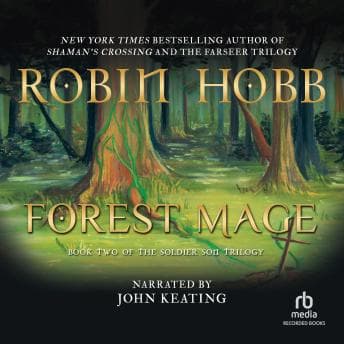

Okay, I need to rant about Nevare Burvelle for a second.
I've listened to a *lot* of fantasy protagonists make questionable decisions. It's basically a genre requirement at this point. But Nevare? This man watches the universe hand him a giant neon sign saying "DON'T DO THE THING" and proceeds to do the thing. Repeatedly. For thirty-one hours. I was stress-eating thesis-procrastination snacks and yelling at my headphones like my D&D party when someone splits the group.
And yet. AND YET. I couldn't stop listening.
Robin Hobb Wants You to Suffer (Affectionately)
Here's the thing about the Soldier Son trilogy that makes it so different from Hobb's Realm of the Elderlings books—this isn't the story of a clever protagonist navigating political intrigue. This is the story of a man trapped between two worlds, two magics, two versions of himself, and he's losing. The Speck magic isn't some cool power fantasy. It's body horror. It's identity erasure. It's watching Nevare's physical form betray him while everyone he loves looks at him with disgust.
The world-building here is Sanderson-level in its internal consistency, but darker. Way darker. Hobb builds this colonial military society with its rigid class structures and then systematically shows you how every single institution fails Nevare. His father. The military academy. His fiancée. The magic system isn't about cool abilities—it's about consumption and sacrifice and what happens when two incompatible worldviews literally fight for control of one body. Ghost Brigades explores similar themes of identity fragmentation, though through sci-fi body-swapping instead of magical possession.
Is it slow? Yeah. This is a 31-hour commitment and I won't pretend otherwise. If you hate detailed world-building, this isn't for you (but you're wrong). The pacing is deliberate in a way that some listeners find plodding. But I'd argue that's the point? You're meant to feel trapped with Nevare, stuck in this grinding inevitability as the magic reshapes him.
John Keating's Quiet Excellence
Keating doesn't do the Steven Pacey thing where every character has a wildly distinct voice. His approach is subtler—tone shifts, emotional coloring, the way he'll let Nevare's internal monologue carry this undercurrent of desperation even when the character is in denial. It works for this particular story because so much of it lives in Nevare's head.
The emotional delivery is where Keating earns his AudioFile Earphones Award. There are moments—Nevare confronting what he's becoming, the scenes with his family—where the narration hit harder than the text alone probably would have. He captures that specific flavor of Hobb protagonists: the ones who suffer beautifully and make you suffer with them.
That said, I can see why some listeners bounced off the pacing. Keating matches the book's deliberate rhythm, which means if you're already frustrated with the plot's momentum, the narration isn't going to artificially speed things up. This is not a 1.0x background listen. I tried that while working on my thesis and retained absolutely nothing. You need focus time for this one.
The Middle Book Problem (It's Real)
Look, I'm not going to pretend this doesn't suffer from middle-book syndrome. Compared to Shaman's Crossing, there's less forward momentum. Less happens in terms of plot. It's the Empire Strikes Back of the trilogy—things get worse, the protagonist loses ground, and you're being set up for a payoff that won't come until book three.
But if you're already invested in Nevare's tragedy—and it IS a tragedy, make no mistake—this book deepens everything. The magic system gets more complex. The colonial critique gets sharper. The horror of what's happening to Nevare gets more visceral.
My D&D group would absolutely use this as inspiration for a body-horror campaign. The way the Speck magic works, the way it creates a literal split self, the moral ambiguity of both sides—it's the kind of fantasy that burrows into your brain and stays there. Third Kingdom has that same grimdark commitment to making its protagonist suffer through impossible moral choices, though Goodkind's approach is less subtle.
Roll for Emotional Damage
**Listen if:** You loved Hobb's Farseer trilogy and want something even bleaker (yes, bleaker than Fitz's life, I know). You want a slow-burn examination of colonialism, identity, and magical body horror with a narrator who commits fully to the emotional weight.
**Skip if:** You need your protagonists to be competent and make smart decisions—you will throw your phone. You're looking for action-packed fantasy with quick pacing.
I finished this at 2 AM instead of working on my thesis. Dr. Patel would be disappointed. I regret nothing.