
I've been putting off writing my thesis for three weeks now because of this audiobook. Thirty-five hours. That's not a book, that's a commitment. That's a relationship. And honestly? Worth every single procrastinated page of my dissertation.
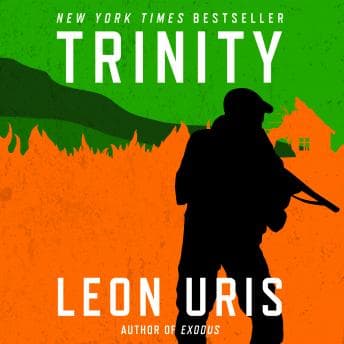
I'd heard people call Trinity "the Irish Exodus" and kind of rolled my eyes because comparisons like that usually disappoint. But here's the thing - they're not wrong. Leon Uris does for Ireland what he did for Israel, and John Keating's narration transforms what could've been a dense historical slog into something that genuinely kept me up past 2 AM on a Tuesday. I had the same “oh no, this is homework now” reaction to Exodus: A Novel of Israel, which is basically Uris doing a different national origin-story campaign. (Dr. Patel, if you're reading this, I was definitely working on my thesis at 2 AM. Definitely.)
The Voice That Made Me Care About Famine Statistics
John Keating is an AudioFile Earphones Award winner, and about four hours in, I understood why. The man doesn't just do Irish accents - he does regional Irish accents. Protestant Ulster sounds different from Catholic Donegal. The English landlords drip with that particular brand of colonial condescension. Scottish characters actually sound Scottish. This is Sanderson-level world-building, but for voices.
What really got me was how he handles Conor Larkin, our main guy. There's this warmth to his voice when Conor's young and idealistic, and you can hear it harden over the decades as Ireland grinds him down. That's not just reading - that's acting. One listener said Keating "makes a good book a brilliant book," and yeah, that tracks. I've listened to plenty of historical epics where the narrator just... reads at you. His work on Renegade's Magic has that same “NPCs suddenly have inner lives” effect, which is unfairly powerful against my productivity. Keating inhabits these people.
When History Hits Like a Nat 20 to the Feels
Okay, so the book itself. This is a multigenerational saga spanning from the Great Famine through the Easter Rising, following Catholic tenant farmers and their Protestant neighbors through decades of British colonial rule. If you don't like info-dumps, this isn't for you (but you're wrong). Uris commits to the world-building. You will learn about linen mills. You will learn about Orange marches. You will have opinions about Parnell.
The central romance between Conor and Shelley - a Protestant woman who defies her entire heritage for him - could've been cheesy. It's not. It's earned through about fifteen hours of buildup, and when it finally happens, you feel the weight of everything they're risking. The progression is satisfying in that slow-burn way that makes the payoff hit harder.
Now, fair warning: this book has a perspective. It's pro-Irish independence, full stop. The British come off pretty badly (I mean, historically accurate, but still). Some listeners have noted it feels one-sided, and if you're looking for a balanced "both sides" treatment of colonialism... this ain't it. Personally? I was fine with it. Uris isn't pretending to be neutral, and there's something refreshing about an author just committing to his thesis. (Unlike me. I should really commit to my thesis.)
Who's Rolling Initiative on This One
This is perfect for anyone who loves epic fantasy world-building but wants it grounded in real history. My D&D group would eat this up - there's enough political intrigue for our scheming rogue player, enough romance for our bard, and enough righteous rebellion for literally everyone else. Skip it if you need fast pacing or want neutral historical analysis; this is passionate, partisan storytelling that takes its time.
Thirty-Five Hours and I Wanted More
This is the wild thing - at 35 hours, you'd expect drag. There are slower sections, sure. Some of the political machinations in the middle act take their time. But Keating's pacing keeps things moving, and honestly, by the end, I was sad it was over. That almost never happens with books this long.
The violence is there - this is Irish history, after all. Famine, rebellion, religious persecution. It's not gratuitous, but it's not sanitized either. Content warning for anyone sensitive to that stuff. But Uris earns the darkness because he also gives you the beauty. The terrible beauty, as the Irish would say.
Campaign Complete, Would Play Again
Yes. Probably during my next thesis-avoidance spiral. Yes, it's 35 hours. Yes, it's worth it. John Keating walked so other narrators could run, and this performance is proof. If you've got a long commute, a cross-country drive, or a dissertation you're actively ignoring, Trinity will fill that time beautifully.
Just maybe don't tell your advisor how you spent your weekend.