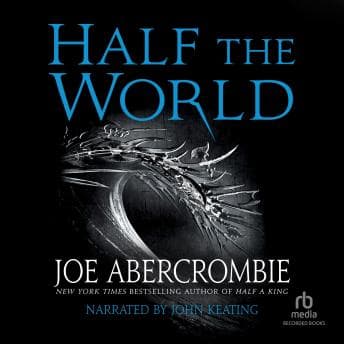

So I'm sitting in my apartment at like 1 AM, supposedly debugging a procedural terrain generator for my thesis, and instead I'm seven hours deep into Half the World wondering why Thorn Bathu feels like a character I've been rolling in D&D campaigns for years but never quite got right. You know that fighter who's all rage and no wisdom score? That's Thorn. Except Abercrombie actually makes you care about why she's like that, which is more than most DMs manage.
The Elephant in the Longboat: Where's Steven Pacey?
Let's just get this out of the way. If you're coming from Abercrombie's First Law trilogy, you've got Steven Pacey's voice burned into your brain like a brand. The man walked so other narrators could run, and I will die on that hill. So hearing John Keating step in for the Shattered Sea series is... an adjustment. Like rolling a new character after your level 20 barbarian died.
But here's the thing - Keating earns his spot. He gives Thorn this Suffolk accent, rounding her 'i' sounds into 'oi,' and at first I was like, "What is happening?" But by hour two, it clicked. That accent is Thorn. She's not from the same world as the polished courtiers and scheming ministers. She sounds different because she IS different, and Keating makes that choice deliberately. Father Yarvi comes through sly and measured, like he's always three moves ahead of whatever conversation he's in - which, if you read the first book, tracks perfectly. And Brand? Good-natured, kind of earnest in a way that makes you want to protect him. Keating nails the contrast between these two leads.
The queens and empresses he voices have this quality that's hard to pin down - delicate but with steel underneath. It's not just "woman voice" the way some narrators phone it in. There's actual character work happening.
Father Yarvi's Long Game (Or: Abercrombie Doing What He Does Best)
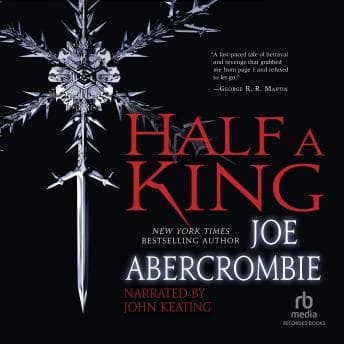
Okay, so this is book two of the Shattered Sea trilogy, and if Half a King was Abercrombie writing a coming-of-age Viking story with training wheels on, Half the World is him kicking those wheels off and letting the bike wobble into full political scheming territory. Father Yarvi is not the POV character anymore, but he's running the show from behind every curtain, and the way Abercrombie weaves his manipulations through Thorn and Brand's storylines is - and I don't use this comparison lightly - this is Sanderson-level world-building, except instead of hard magic systems you get hard political systems. Every alliance has a cost. Every favor is a leash. That same ruthless political escalation drives Great Hunt: Book Two of 'The Wheel of Time', where the stakes ratchet up from book one in ways that feel earned rather than inflated — and honestly, both sequels nail the "middle book that's actually better" trick.
Thorn's arc is the real engine here. She starts as someone who only knows how to solve problems with violence, which, relatable (my D&D group would love this character). But the journey across half the world - literal title drop - forces her into situations where punching isn't the answer. The fight scenes still slap, don't get me wrong. Abercrombie writes combat like he's choreographing it, and Keating's pacing during those sequences keeps the energy tight. But it's the moments between fights where the book actually earns its emotional weight.
Brand is the quieter half of this equation. A warrior who hates killing in a world that only values killers. He's the moral center, and in lesser hands he'd be boring. He's not boring. Keating gives him this forthright, slightly vulnerable delivery that made me actually root for the guy.
The 13-Hour Sweet Spot
At 13 hours, this sits in that perfect range where it's substantial enough to feel like a real journey but doesn't overstay its welcome. The pacing is tighter than Half a King, and the shift to dual protagonists gives you natural rhythm - Thorn chapters hit harder, Brand chapters let you breathe. I burned through the last five hours in one sitting when I should've been writing my thesis. (I read this instead of writing my thesis. Dr. Patel, if you're reading this, I was doing "research on narrative structures in serial fiction.")
If you don't like info-dumps, this isn't for you - but you're wrong. Abercrombie layers his world-building into the travel narrative so the political landscape unfolds as Thorn discovers it. It's efficient. You're learning the stakes at the same pace as the characters.
One note: this is a middle book. It does middle book things. There's setup here for book three that won't pay off yet, and some of Yarvi's machinations are clearly long game plays. If that bugs you, fair warning.
Who Gets On This Boat
If you liked Half a King, this is better. The progression is satisfying. If you're an Abercrombie fan who's been avoiding Shattered Sea because it's "YA" - it's Abercrombie YA, which means teenagers getting their teeth knocked out and learning that the world is fundamentally unfair. So, you know, still on brand.
Skip this if you need your fantasy narrator to sound exactly like Steven Pacey, because nobody does. But Keating's doing his own thing, and his own thing is pretty damn good once you stop comparing.
My Advisor Would Call This "Scope Creep"
I went in expecting a decent follow-up and came out wanting to immediately start book three. The magic system is chef's kiss - wait, there barely is one. That's kind of the point. This is Abercrombie's grimdark sensibility applied to a leaner, meaner framework, and Keating's narration holds it together with genuine craft. Not a must-listen-drop-everything situation, but absolutely worth a credit. Especially at 1 AM when your thesis can wait.