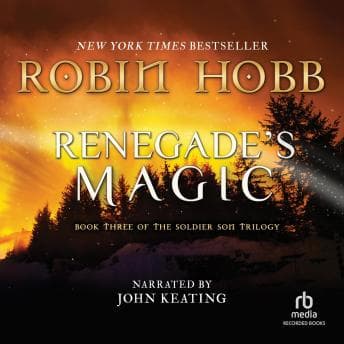

Robin Hobb is supposed to be the gold standard. The Farseer trilogy sits on my shelf like a sacred text. So why did I spend 29 hours with Renegade's Magic feeling like I was watching a horror movie through frosted glass—knowing something devastating was happening but never quite feeling the full impact?
I listened to this during a string of late-night shifts at the library, processing returns in the dim back room while everyone else had gone home. Perfect setting for Hobb's brand of psychological torment, right? Except the torment never quite landed.
The Dual-Soul Problem (And Why It Should Work Better)
Here's the thing about possession narratives in horror and dark fantasy: they work when you feel the violation. The wrongness of something else wearing your skin. Nevare's split with Soldier's Boy—this ruthless Speck-magic alter-ego—should be terrifying. Giving Up The Ghost plays with similar possession themes, though it delivers the visceral punch this one lacks. It's body horror meets identity horror, my absolute sweet spot.
But Hobb keeps us at such a distance from the visceral experience that I found myself intellectually understanding Nevare's crisis rather than feeling it in my gut. When Soldier's Boy conducts his raid, when the magic twists Nevare into actions he'd never choose, I wanted to feel sick. Instead, I felt... informed. The detailed descriptions that listeners complain about as "slow" or "wordy" aren't the problem. The problem is that all that prose somehow fails to put us inside the horror of losing yourself.
John Keating's British-Scottish Divide
Keating uses a British accent for narration and Scottish for most characters—except Nevare and his family. It's an interesting choice that creates immediate class and cultural distinction. You hear the divide between the colonizing Gurnians and everyone else before you fully understand it.
But here's where it gets weird: the Specks—this entirely separate culture with their own magic system and worldview—sound basically the same as the Gurnian outlanders. They're supposed to be alien, fundamentally other. The magic that's consuming Nevare comes from a people whose entire existence challenges everything he was raised to believe. And they just... sound like everyone else. I had similar narrator frustrations with Battlefield Earth, where distinct alien cultures needed vocal differentiation that didn't quite land.
The women suffer most. Keating's female voices lack distinction, and in a book where Nevare's relationships with women (his fiancée, the Speck women, the women he's wronged) carry significant weight, this flattens crucial emotional beats. When I couldn't immediately tell which woman was speaking without context clues, I'd lose the thread of scenes that should have hit harder.
His pacing, though? Genuinely excellent. For a 29-hour commitment, he keeps the momentum steady. No rushing through the quiet moments, no dragging through the action. The man understands that Hobb's work requires patience.
Where the Threads Finally Pull Together
I'll give the ending this: when the plot threads finally come together, you can see what Hobb was building. The exploration of Speck culture, the cost of colonization, the question of whether Nevare can ever truly reclaim himself—it's ambitious. Some listeners cried. Some felt the emotional complexity paid off everything they'd invested.
I felt... ambivalent. Which might be the point? The ending refuses easy catharsis. Nevare's transformation isn't triumphant in any traditional sense. If you're looking for the satisfaction of Hobb's other conclusions, you might leave frustrated.
Who Should Commit to 29 Hours of This
If you've read the first two Soldier Son books, you're probably finishing regardless of what I say. Fair enough. If you're a Hobb completist, this is required listening—just know it's considered lesser work compared to the Elderlings books.
Skip if: you're hoping for the gut-punch emotional precision of Assassin's Apprentice. Skip if you need distinct female voices to stay engaged. Skip if 29 hours of psychological complexity without horror's visceral payoff sounds exhausting.
Listen if: you appreciate slow-burn fantasy that prioritizes internal conflict over external action. Listen if colonization narratives and identity horror interest you conceptually, even when the execution is uneven. Listen if you have the patience for Hobb's detailed worldbuilding and trust that she's going somewhere.
Shirley Slept Through the Whole Thing
My cat remained unimpressed by my entire listening experience, which feels appropriate. This isn't the kind of dark fantasy that makes you gasp or check the shadows. It's the kind that makes you think, then think some more, then wonder if you should have felt more than you did.
Robin Hobb walked so other authors could run. But sometimes, even she stumbles. Renegade's Magic is a stumble—an ambitious, thoughtful stumble with moments of genuine power, but a stumble nonetheless. The horror of losing yourself to magic that doesn't care about your consent? It's there. It's just muffled. And after 29 hours, muffled isn't quite enough.