
Okay, look. We need to address the elephant in the server room immediately.
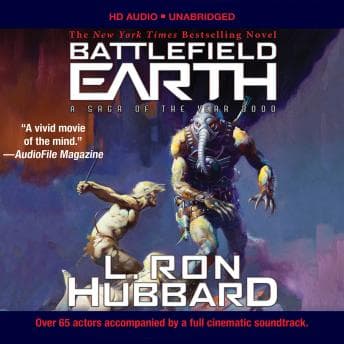
Yes, it's L. Ron Hubbard. Yes, there's baggage there. But I approach audiobooks like I approach legacy code: I don't care who wrote the documentation, I just want to know if it compiles. And honestly? This production compiles. It runs. It actually kinda sprints.
I picked this up because I had three weeks of intense commuting ahead of me—SOMA to Mountain View, five days a week, the full slog—and I needed a time-sink. I saw "Full Cast" and "Sound Effects" and figured, why not? The ROI on one Audible credit for this much content is absurd.
A Blockbuster Movie (Without the Visuals)
Let's be real for a second. Most audiobooks are just a guy in a booth reading text. This? This is an audio engineering flex.
They claim 150,000 sound effects. I didn't count them (obviously), but my noise-canceling headphones certainly felt them. We're talking laser blasts, ambient spaceship hums, wind, footsteps. It's not just background noise; it's a full soundscape.
There are moments where the production value is so high it actually startled me. I was zoning out on the train, staring at the gray landscape of San Mateo, and suddenly a blast sequence kicked in that made me jump. It's immersive. High definition. Basically, it turns your commute into a cinema experience. If you're a tech nerd like me, you'll appreciate the sheer bandwidth of effort that went into the sound design. It's clean, crisp, and surprisingly well-mixed.
The Cast: A Feature, Not a Bug?
It's not just one narrator. It's a literal army. 65 actors.
Stefan Rudnicki is here, and if you know audiobooks, you know that deep, gravelly voice is basically the gold standard for sci-fi. Josh Clark handles the main narration and keeps the pacing tight. But here's the thing—because it's a full cast, the character differentiation is absolute. You never wonder "Wait, who is talking right now?" which is a common issue I have with single-narrator epics.
However—and there is a "however"—the acting choices are... bold.
The main villain, Terl? (Yikes.) The performance is definitely distinct, but it leans hard into "cartoon bad guy." Think Saturday morning villain twirling a mustache. At first, I rolled my eyes. It felt a bit too pulp, a bit too cheesy. But around hour 10? I just accepted it. It fits the vibe. This isn't hard sci-fi like The Three-Body Problem; it's an adventure romp. Eldest has that same pulpy energy—big stakes, scrappy heroes, and enough momentum to power through a week of commutes. You have to embrace the cheese.
The "Commute-Worthiness" Verdict
Is it too long? Probably. (Could've been a blog post? No. But maybe a shorter series.)
The story is pure pulp fiction. Humans are the underdogs, aliens are the oppressors, and there's a lot of scrappy fighting back. It drags in the middle—classic bloat—but the sound design usually pulled me back in just as I was reaching for my phone to check Slack.
If you treat this as a mindless, high-budget action movie for your ears, it works. It got me through a month of commutes without me needing to search for a new title. For that utility alone? Solid 4 stars. Just don't expect deep philosophical questions about the nature of consciousness. Expect lasers.
Who should listen: Long-haul commuters who want maximum runtime per credit and don't mind pulpy adventure. Skip it if you need hard sci-fi or can't handle campy villain performances.
Bottom Line: Come for the sound effects, stay because you're 20 hours in and suffer from sunk cost fallacy. (But in a good way.)