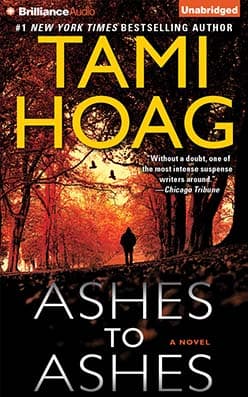

Look, I need to rant for a second. Fourteen and a half hours. That's what this book asks of you. And for the first, oh, maybe nine of those hours, I kept thinking: Tami Hoag, I love you, but did your editor go on vacation? Because there are scenes in this book that circle the same drain two, three times before moving on, and as someone who charts patient vitals for a living, I know redundancy when I see it.
But here's the thing - I almost quit around hour eight. I was lying on the couch at 2 PM, blackout curtains drawn, the house finally quiet because Carlos took the kids to his mom's. I should've been sleeping. Instead I'm staring at the ceiling listening to David Colacci walk me through yet another Minneapolis PD jurisdictional pissing contest, and I'm thinking, "Maria, just close your eyes and let this go." I didn't. And I'm glad.
The First 70% Will Test Your Loyalty
The setup is solid - an Internal Affairs cop found hanging in front of a mirror with "Sorry" written on it, staged to look like autoerotic asphyxiation or suicide. Kovac and Liska don't buy it. Classic procedural bones. Hoag knows how to layer suspects: the dead cop's wife, his partner, the people he was investigating, the brass who want the whole thing buried. Every chapter peels back another layer of Minneapolis PD politics, and the institutional corruption angle feels genuinely lived-in, not like someone watched a Law & Order marathon and took notes. Shamed does something similar with small-town institutional rot - that same slow-burn sense that the corruption goes deeper than anyone with a badge wants to admit.
But the pacing. Oh, the pacing. There are interrogation scenes that go on for twenty minutes when five would've landed harder. Hoag has this habit of having characters rehash information we already know - Kovac explains the case to a superior, then Liska explains it to someone else, then we get internal monologue covering the same ground. I kept wanting to grab a red pen and start crossing things out. My night shift brain was screaming "get to the point, we have twelve patients and three admissions coming up from the ER."
That said? The last 30% of this book hits different. When the connections between the current case and a twenty-year-old murder start clicking into place, Hoag earns back every slow minute she spent building. The reveal isn't just about who did it - it's about how deeply rot can set into an institution that's supposed to protect people. That part? That part I felt in my bones. I've worked in a system long enough to know what it looks like when people protect the institution over the people it serves.
Colacci Knows How to Work a Bullpen
David Colacci carries this thing on his back for almost fifteen hours, and he does it well. His Kovac has this weary, gravel-voiced energy - the guy who's seen too many bodies and drinks too much coffee and still shows up. His Liska is sharper, faster, with just enough bite that you can hear her refusing to be patronized. I never once lost track of who was talking, which in a book with this many cops and suspects and witnesses is no small thing.
He's not flashy. No dramatic pauses that make you think the narrator is auditioning for a one-man show. Just clean, steady work that lets the story breathe. For a 14-hour listen with a single narrator, that consistency matters more than fireworks.
The Medical Stuff (Because You Knew I'd Go There)
The autopsy and forensic details are... fine. Nothing made me yell at my dashboard, which is honestly the highest compliment I can give a thriller. The hanging scene mechanics and the way the ME discusses ligature marks - it tracked. This is not how hospitals work. Trust me - I've read enough books where the author clearly Googled "cause of death" five minutes before writing the scene. Hoag did her homework, or at least didn't embarrass herself.
Who Gets the Green Light
If you love police procedurals - the real gritty, political, who's-covering-for-whom kind - this is your book. Fans of Michael Connelly's Bosch series will feel right at home with Kovac's cynical competence. If you need breakneck pacing, if you want a thriller that never lets up? You're going to struggle through the middle. I almost did. Someone told me the last 30% was worth it, and they were right, but that's a big ask.
Perfect for that post-shift decompression, actually. The slow build matches that gradual unwinding from adrenaline to exhaustion. Just know what you're signing up for - this is a marathon, not a sprint. And maybe bump it to 1.25x for those middle chapters. I did. No shame.
Night Shift Ruling: Guilty With Time Served
Carlos asked why I was still awake at 4 PM. I told him the Minneapolis PD was corrupt and I needed to see justice done. He brought me coffee and didn't ask follow-up questions. That man knows me. This book isn't perfect - it's overlong and it telegraphs its villain if you're paying attention - but when it lands, it lands hard. Picture on the Fridge lands the same way for me - not a perfect book, but the gut-punch at the end makes you forgive everything that tested your patience getting there. Hoag understands that the scariest thing about institutional evil isn't the monster. It's everyone who looks the other way.