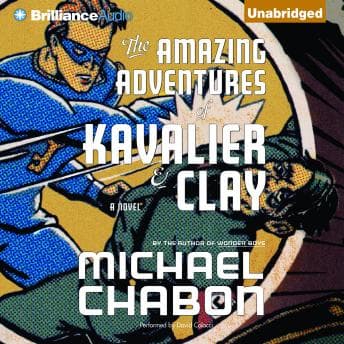

Twenty-six hours. That's what this book asks of you. Twenty-six hours and twenty-five minutes, to be precise—roughly the same amount of time I spend each week convincing teenagers that symbolism isn't a conspiracy invented by English teachers to torture them. And I'll tell you right now: Chabon earns every single minute.
But here's my complaint. I started this during a Saturday morning lakefront walk with Denise, thinking I'd knock out a few chapters while we did our usual loop. Three weeks later, I'm still listening. I've graded two full class sets of essays to the sound of Joe Kavalier's voice. I've pretended to take notes during a curriculum meeting while actually learning about the Golden Age of comics. Principal Martinez definitely noticed me smiling during the budget projections. (Sorry, not sorry.)
The Escape Artist and the Dreamer
This reminds me of what Hemingway said about writing—that you have to show the iceberg, not describe it. Chabon does something similar but inverted: he gives you the whole iceberg, every frozen inch of it, and somehow makes you grateful for the excess. Joe Kavalier's escape from Prague—and I mean his literal, physical escape, hidden inside a coffin with the Golem of Prague—sets the tone for everything that follows. This is a book about escape. Escape from fascism, from grief, from the limitations of your own body and circumstances. The Escapist, the superhero Joe and Sammy create, isn't just a clever metafictional device. He's the externalization of everything these two Jewish boys in 1939 Brooklyn desperately need to believe is possible.
David Colacci understands this. His Czech-accented English for Joe carries this weight of displacement, this sense of a man perpetually between worlds. When he shifts to Sammy's Brooklynese—that particular rhythm of mid-century New York Jewish speech—you feel the contrast immediately. These are cousins, technically family, but they come from different planets. The prose deserves to be savored, and Colacci savors it.
Where Colacci's Accents Get a Little Blurry
Now look. I teach literature. I notice things. And I noticed that Colacci's Eastern European accents sometimes blur together in ways that would make my colleague in the history department wince. His German, Czech, and Russian characters occasionally sound like they all attended the same Generic Old World Accent Academy. There's a moment where he pronounces "Bubbe" as "Buh-bee" instead of the proper Yiddish "Buh-beh," and I actually paused my grading to frown at my phone.
But here's the thing—and this is why I can't dock him too heavily—his emotional delivery transcends these technical hiccups. When Joe Kavalier grieves, when he rages, when he creates, Colacci's voice carries that truth. I was walking past the Shedd Aquarium during one of Joe's darker moments and had to stop, just stand there like an idiot watching the seagulls, because the performance had grabbed me by the throat.
The Comic Book Chapters Are Actually Brilliant
My students would hate this. I love it.
Chabon interrupts his own narrative to give you actual comic book plots—the adventures of the Escapist, the mysterious Luna Moth. In print, these sections have a different visual quality. In audio, Colacci has to sell you on the inherent absurdity and beauty of superhero storytelling using only his voice. The humorous quips land—I laughed out loud during one of the more ridiculous Escapist scenarios, startling a jogger on the lakefront path. But more importantly, he makes you understand why these stories mattered. Why two boys needed to create a hero who could punch Nazis when the real world offered no such satisfactions.
This is why we still read the classics. Or in this case, why we listen to them. Waste Land explores that same idea of art as survival, though through a completely different lens. Chabon wrote this in 2000, but it's already a classic—a book about how we use stories to survive the unsurvivable.
Who Needs This in Their Ears (And Who Doesn't)
If you loved "The Yiddish Policemen's Union" or "Wonder Boys," this is Chabon at his most ambitious. If you're a comics fan who wants literary fiction that takes the medium seriously—not as kitsch, not as nostalgia, but as genuine American mythology—you need this. If you appreciate a narrator who can make you feel the difference between a Brooklyn tenement and a Prague parlor, even if his accent work isn't linguistically perfect.
Skip it if you need fast pacing, you're looking for background listening, or 26 hours feels like a prison sentence rather than an invitation. This is focused listening territory. You can't half-pay-attention to Chabon's sentences; they're too dense, too rewarding.
Worth Closing Your Classroom Door For
I finished the last chapter during my prep period, door closed, lights off, feet on my desk like a teenager hiding from responsibility. The ending—which I won't spoil—made me think about all the escapes we attempt in our lives. The ones that work. The ones that don't. The ones that cost us everything and still somehow feel worth it.
Twenty-six hours. My students would say that's insane. But they also say reading is boring, so what do they know? This is a book about two boys who believed that art could save them, and in some ways it did, and in some ways it couldn't. Colacci gives you space to feel what Chabon is really saying—the narrator understands that pause is punctuation.
If you loved "A Tree Grows in Brooklyn" or "The Chosen," this is their spiritual successor—bigger, stranger, more ambitious. Not perfect. But the imperfections are human ones, and human imperfections are what great literature is made of.