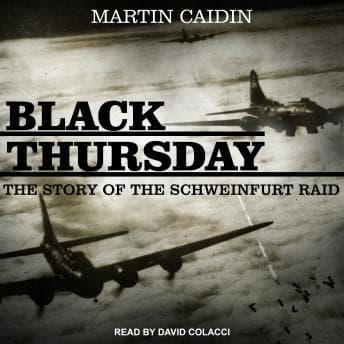

Look, I need to get something off my chest right up front: Martin Caidin wrote this book in 1960 and it still makes half the modern WWII aviation books on my shelf look like book reports. That irritates me a little, honestly, because it means we've been going backward in how we tell these stories.
I finished this one at 0200 on a Tuesday, sitting on my back porch with Ranger curled up at my feet and a bourbon I'd forgotten about going warm on the armrest. Couldn't stop. Didn't want to.
291 Went Out. 60 Didn't Come Back.
Let me cut to the chase - those numbers are the whole ballgame. October 14, 1943, Schweinfurt. The Eighth Air Force sent 291 B-17s to knock out Germany's ball bearing production, and what happened over the next several hours was a systematic mauling. Six hundred and fifty men killed, wounded, or captured. Sixty bombers gone. And Caidin doesn't let you hide from any of it.
What separates this from a Wikipedia summary is the ground-level construction. Caidin was an aviation guy - a real one, a pilot who restored a 1936 Junkers Ju 52, not some armchair historian - and it shows in how he builds the mission from the dirt up. The ground crew preparations aren't throwaway setup. You get the mechanics, the armament loading, the pre-flight checks, and Caidin treats those men with the same respect as the flight crews. Because he understood that a bomber mission starts long before wheels-up. The briefing scenes carry real weight because Caidin sourced them from the people who were actually sitting in those rooms, watching the red string on the map run deep into Germany and doing the math on fuel versus fighter coverage.
I've been in briefings where you know the plan has gaps. Where nobody says it out loud but everybody's thinking the same thing. Caidin captures that tension without dramatizing it into something Hollywood. It's just... quiet dread dressed up as professionalism. I've seen that scenario play out in real life, different war, same math.
Where the Flak Gets Thick
The battle sequences are where Caidin earns his keep. Once those B-17s cross into German airspace without fighter escort - because the P-47s didn't have the range to go all the way to Schweinfurt, a fact that should've been a bigger red flag than it was - the Luftwaffe hits them in waves. Caidin pulls from first-hand accounts and survivor interviews to reconstruct the running air battle, and the specificity is what makes it land. He's not writing "and then the fighters attacked." He's writing about individual crews, individual moments - the tail gunner watching a formation mate fold in half, the pilot holding steady on the bomb run while his aircraft is getting chewed apart.
The author clearly did their homework. Caidin cross-references American and German sources, which for 1960 was ahead of the curve. You get the Luftwaffe perspective too, not as caricature enemies but as tacticians exploiting an obvious vulnerability in the American daylight bombing doctrine. That intellectual honesty is rare and I respect the hell out of it.
Now - this is where I have to be straight with you. The book is a product of its time. Caidin's prose occasionally tips into the patriotic register of postwar aviation writing, and some of his strategic analysis has been complicated by later scholarship. But the core narrative, built from those interviews and mission records, holds up.
Colacci Behind the Mic
David Colacci handles the narration with clean, professional delivery. No theatrics, no dramatic voice acting - which is exactly right for this material. This isn't a thriller; it's history that happens to be terrifying. Colacci reads it like a good intelligence briefer: clear, measured, letting the facts carry the emotional payload. At 1.25x he hits a good stride, keeps the momentum without rushing past the details that matter.
Single narrator, no sound effects, no production gimmicks. Just a man reading a well-written book about a very bad day. Sometimes that's all you need.
Who Needs This In Their Ears
If you care about WWII aviation, this is essential. Period. If you've read Ambrose or Kershaw and want something with sharper tactical focus and less sentimentality, Caidin delivers. If you're active duty or veteran and you understand what it means to execute a mission when the plan is already falling apart - this one's going to hit different.
Skip it if you need a strong character arc or narrative structure beyond chronological reconstruction. This is mission history, not a novel. It does what it does and does it well.
Mission Debrief
Worth your time? Here's the debrief: nine hours of serious, well-sourced WWII aviation history narrated by a pro who knows when to get out of the way. It's not flashy. It's not trying to be a movie. It's trying to make sure 650 men don't get reduced to a statistic, and on that count - mission accomplished. I'll say this much - the books that stick with me longest are the ones that treat real people like real people, and I found that same quiet insistence on human dignity in Noble Woman: The Life-Story of Edith Cavell, different war, different theater, same refusal to let the historical record swallow the individual whole.
Ranger slept through most of it. I didn't.







![Steve Jobs [unabridged audiobook] audiobook cover](/_next/image?url=https%3A%2F%2Fcovers.audiobooks.com%2Fimages%2Fcovers%2Ffull%2F9788499923406.jpg&w=1920&q=75)