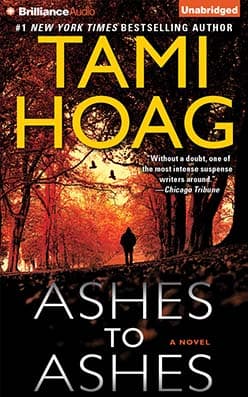

What makes a serial killer thriller actually work in audio form? Because let's be honest — most of them blur together after a while. You've got your damaged investigator, your enigmatic killer with a ritualistic M.O., your ticking clock. The ingredients are so familiar they're practically a genre Mad Lib. So when one actually gets under your skin at 1 AM while you're sitting in your reading chair with Shirley asleep on the arm rest and every shadow in your peripheral vision suddenly feeling intentional — that says something.
Ashes to Ashes grabbed me sideways. I wasn't expecting it to.
The Slow Burn That Earns Its Eighteen Hours
Look, 18 and a half hours is a commitment. That's longer than most horror novels I cover on the podcast, and this is a thriller — a genre that usually trades in urgency. Hoag does something interesting here: she slows down where other writers would sprint. The killer's ritual — the anointing, the fire, the staged bodies in a Minneapolis park — gets established early, but the book isn't really about catching him. Not primarily. It's about the web of relationships between Kate Conlan, the victim/witness advocate with an FBI past she'd rather forget; John Quinn, the profiler who represents everything she left behind (and then some); and this witness who won't talk, who might be a victim, who might be something else entirely.
That ambiguity around the witness is where Hoag does her best work. She doesn't tip her hand. You're watching Kate try to read this person, and you're doing the same thing, and you keep second-guessing yourself. It's the kind of psychological tension that doesn't rely on jump scares or gore — and I say this as someone who appreciates a good gore moment — but on genuine uncertainty about who to trust. Sharp Objects does something similar — that same slow erosion of certainty about who in the story is dangerous and who is just damaged. Shirley Jackson walked so this kind of character-driven suspense could run.
The billionaire father angle, Peter Bondurant pulling strings to get the FBI involved, could've felt like a cheap plot device. And honestly? In spots it skirts that line. But Hoag uses it to complicate the power dynamics rather than simplify them. The case isn't just about solving murders — it's about who controls the investigation, who gets protected, who gets sacrificed. That's horror adjacent, even if the genre label says thriller.
Colacci Knows When to Pull Back
David Colacci. I wasn't familiar with his work before this, and I should've been. The narrator commits. That's rare. What struck me most is his restraint with the female characters — specifically Kate. Male narrators voicing female leads in thriller audiobooks can go wrong in about fifteen different ways, and most of them involve pitched-up voices that sound like a man doing a bit. Colacci doesn't do that. He shifts his cadence, drops his energy into a different register, and lets the writing carry the gender distinction. Kate sounds like a woman who's tired and competent and angry, not like a man pretending to be one.
His Quinn voice has this controlled authority to it — measured, almost clinical — which works perfectly for a profiler character who's used to being the smartest person in the room but who's also carrying baggage with Kate that keeps leaking through the composure. The contrast between Quinn's public performance and the moments where his history with Kate surfaces? Colacci nails that shift. Subtle enough that you feel it before you consciously register it.
I will say — and this is minor — that at 18+ hours, there are stretches in the middle where the pacing goes procedural in a way that Colacci can't fully save. Hoag lays in a lot of investigative groundwork that's necessary for the payoff but occasionally reads like someone transcribing case notes. The audio makes this easier to absorb than reading it on the page would be, but I'd be lying if I said I didn't zone out for a few minutes somewhere around hour 10.
Who Gets Burned, Who Should Walk Away
If you're a thriller fan who prefers character psychology over action set pieces, this is your book. If you want something that understands the dynamic between law enforcement egos, institutional politics, and the people who actually suffer — the victims who become bargaining chips — Hoag gets it right. Content warnings for violence, abuse, sexual content, and strong language. This one doesn't shy away from the darkness of its premise.
If you need a fast-paced page-turner that hits the gas early and never lets up? This isn't that. It's a slow burn. It earns its length, mostly, but it is long.
My podcast listeners are going to love this — especially the ones who keep asking me for horror-adjacent thrillers that actually respect character work.
Worth Burning a Credit On
I listened in the dark. Mistake? Maybe. Worth it? Absolutely. Ashes to Ashes isn't horror by genre classification, but the ritualistic killer, the atmospheric Minneapolis winter setting, and that gnawing question of whether the witness is predator or prey — it scratches the same itch. Colacci's performance elevates solid source material into something that justifies the audiobook format entirely. If this is what the rest of the Kovac and Liska series sounds like, I've got some catching up to do.