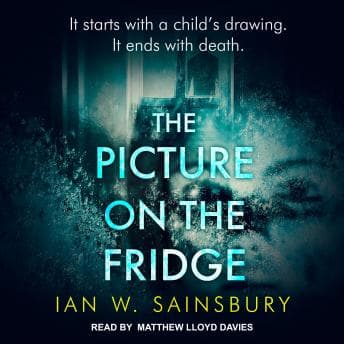
I was reorganizing the horror section at the library—yes, at 8 PM, yes, alone, yes, I'm aware of the irony—when I decided to finally start this one. Picture on the Fridge had been sitting in my queue for weeks, and something about alphabetizing Shirley Jackson next to Stephen King put me in the mood for psychological unraveling. Good call, past Jordan.
Here's what I knew going in: unreliable narrator, family secrets, a child's drawing that shouldn't exist. Classic setup. What I didn't expect was how effectively Ian W. Sainsbury would weaponize maternal paranoia. Mags Barkworth isn't just doubting her husband—she's doubting her own sanity, her medication, her therapy, every foundation she's built since whatever tragedy shattered her over a decade ago. And when her daughter Tam draws a hyper-detailed picture of a place she's never been? That's when the floor drops out.
The Slow Poison of Doubt
Sainsbury understands that horror isn't about gore—it's about dread. He doesn't rush the reveal. He lets you marinate in Mags's uncertainty, which is honestly more unsettling than any jump scare. Is her husband lying? Is she losing her grip again? The voice in her head—the one she's been medicating into silence—starts whispering, and you can't tell if it's paranoia or intuition. That ambiguity is the engine of this whole thing.
I've listened to a lot of psychological thrillers that promise "you won't see the twist coming" and then deliver something you absolutely saw coming three hours ago. This one? I had theories. I was wrong. Not in a cheap gotcha way, but in a way that made me recontextualize everything I'd heard. Head Full of Ghosts pulled off that same kind of earned misdirection—the kind that makes you want to immediately relisten. Sainsbury earned that twist.
Matthew Lloyd Davies: Brilliant Until He Crosses the Atlantic
Okay. Let's talk about the elephant in the room—or rather, the Boston accent in the audiobook.
Matthew Lloyd Davies is genuinely excellent at what he does best. His British character work is sharp and distinct. He captures Mags's fractured internal state with this barely-contained tremor that made me hold my breath during her spiral moments. When he's in his wheelhouse, he commits. That's rare.
But then someone has an American accent. And suddenly I'm yanked out of this carefully constructed dread because—I'm sorry—that Southern drawl sounds like someone doing a community theater production of Steel Magnolias after watching it once. The Boston accent is somehow worse. It's distracting in a way that genuinely undercuts otherwise tense scenes. My podcast listeners are going to have opinions about this one.
Here's the thing: I don't think a male narrator voicing a female protagonist is inherently a problem. Done well, it works. Davies mostly makes it work—Mags feels authentic, her voice distinct from the other characters. But those accent attempts? They're the audio equivalent of a boom mic dropping into frame. You can't unsee it.
Who Should Listen (And Who Should Bail)
If you're here for a slow-burn psychological thriller that trusts you to sit with discomfort, this delivers. The pacing rewards patience—it's not a sprint, it's a gradual tightening of the noose. Skip if bad accents pull you out of a story completely; you might want to read this one instead. Or push through and accept that every American character is going to sound slightly unhinged in ways the author didn't intend.
Also worth noting: this gets dark. Murder, psychological manipulation, the particular horror of not trusting your own mind. Content warnings exist for a reason, and this one earns them.
Shirley Would Approve (My Cat Remains Neutral)
I finished this at 1 AM, lights off, Shirley (the cat, not Jackson) curled up on my chest like a furry weighted blanket. Did I have to sit there for a minute processing? Yes. Did I immediately start drafting episode notes for The Witching Hour? Also yes.
Sainsbury won the Kindle Storyteller Award in 2019, and you can feel why. He understands pacing. He understands how to plant seeds that bloom into something awful. He understands that the scariest thing isn't what's lurking outside—it's the possibility that you've been wrong about everything. That internal dread is what separates genuine psychological horror from cheap thrills—something P Is for Peril also understood, even if it leaned more mystery than outright terror.
Finally, horror that respects the genre. Just... maybe close your eyes during the American accents.