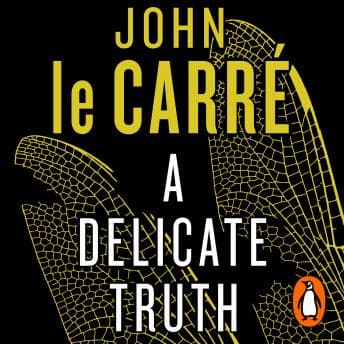

Look, I need to complain about something first. John le Carré wrote a book about the moral rot at the heart of the war on terror, the unholy marriage between government ministers and private defense contractors, the way good people become complicit through silence—and then he narrated it himself at 81 years old with such controlled fury that I forgot to eat dinner. Twice. This is deeply inconsiderate behavior from a man who's been dead for three years and still managed to ruin my sleep schedule.
I listened to this in the dark. Obviously. My apartment, 11 PM, Shirley curled up on the couch looking judgmental. And here's the thing about A Delicate Truth that makes it perfect horror-adjacent listening: it's not about monsters under the bed. It's about the monster that is institutional cowardice. The dread builds not from jump scares but from watching decent people make small compromises until they're standing in a pit they dug themselves.
The Voice That Built These Walls
Le Carré reading his own work is—and I don't say this lightly—an experience that shouldn't work but absolutely does. He's not a trained narrator. He's an 81-year-old former intelligence officer with an axe to grind and fifty years of accumulated rage about what his country has become. You can hear it. The way he voices the ambitious Foreign Office Minister has this particular oily smoothness that made my skin crawl. The private defense contractor gets a different register—bluff, confident, the kind of voice that says "plausible deniability" while ordering another whisky.
But it's Toby Bell, our conscience-stricken protagonist, where le Carré's narration becomes something else entirely. There's a tenderness there, almost paternal. Like he's trying to protect this character from what's coming even as he writes him into the fire.
The Gibraltar operation—codenamed Wildlife—unfolds across two time frames, and le Carré handles the transitions with expert precision that never once confused me. Three years collapse and expand. You're in a Cornish manor house watching a retired diplomat crumble, then you're back in the moment when everything went wrong, and the narrator's voice shifts just enough to signal the temporal leap without hitting you over the head with it.
Where the Anger Lives
Some listeners apparently find the tone "relentlessly angry." To which I say: good? The book is about a botched counter-terror operation that gets covered up, about the private military contractors who've wormed their way into the heart of British foreign policy, about what happens when "the special relationship" means American interests trump everything else. Le Carré is furious. He should be.
The American characters do veer toward caricature—I'll grant that criticism. There's a certain broadness to how they're written and voiced that feels less like observation and more like score-settling. But honestly? After everything le Carré witnessed in his career, I'm inclined to let him have his grudges.
What keeps this from becoming a polemic is the human cost. Big Little Lies understands this too—that the most devastating stories are about ordinary people crushed by systems they can't escape. Sir Christopher Probyn, the retired diplomat whose manor house becomes the setting for revelation, is drawn with genuine compassion. He's a man who did what he was told and is now drowning in the consequences. His daughter Emily, watching her father disintegrate while trying to protect him, represents something le Carré clearly believes in: that the next generation might still choose differently.
The Climax That Earned Its Darkness
I won't spoil it, but the ending involves uncovering what actually happened during Wildlife, and le Carré delivers it with a kind of controlled devastation. The narrative dominoes fall with precision, yes, but what got me was the moral weight. Sinister deaths. Casual torture mentioned in passing like it's nothing. Wrecked lives and shameful compromises.
This understands that horror isn't about gore—it's about dread. The dread of knowing that the system protects itself. That good men who do nothing aren't just passive; they're complicit.
Shirley was unimpressed. I was shaken.
Who Needs This in Their Ears (And Who Should Run)
If you want a thriller with clear heroes and villains, skip. If you want explosions and chase scenes, absolutely skip. This is a slow-burn moral reckoning that requires your full attention—not background listening, not workout fuel. It demands a dark room and your complete focus. President Is Missing: A Novel tackles similar institutional rot, though with less moral complexity and more explosions.
But if you've ever wondered what happens when the war on terror comes home, when the lies told abroad start poisoning domestic institutions, when the people who should know better choose not to—le Carré has been thinking about this for fifty years, and A Delicate Truth feels like his summation.
My podcast listeners are going to love this. It's not horror in the traditional sense, but it's horror in the way that matters: it shows you something true and terrible and dares you to look away.
An Old Spy's Final Testimony
Ten and a half hours. No sound effects, no music, just an old man's voice telling you exactly what he thinks of the world he helped build and then watched betray itself. Le Carré died in 2020. This recording, made in 2013, feels like testimony. Like evidence.
I listened in the dark. Mistake? Maybe. Worth it? Absolutely.