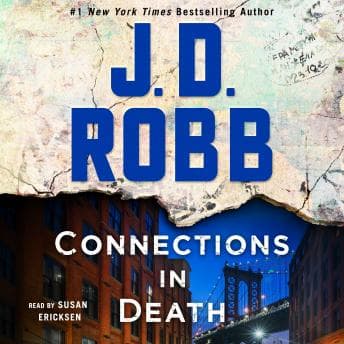

I picked up Connections in Death while jogging through Cambridge at 6 AM, and somewhere around mile three, I realized I'd stopped running and was just standing on the sidewalk, completely absorbed in Eve Dallas's investigation. A jogger passed me twice. I didn't care.
This is book 48 in the In Death series. Forty-eight. That's not a typo. And here's the thing about J.D. Robb (Nora Roberts, for those keeping score at home): she understands something fundamental about human psychology that most thriller writers miss. People don't change overnight. Trauma doesn't resolve in a single book. And the relationships we build—romantic, professional, familial—they evolve in these messy, incremental ways that feel real.
The Psychology of Second Chances
What grabbed me about this particular entry isn't the murder itself—though the setup is genuinely heartbreaking. Lyle Pickering, a man who clawed his way out of addiction and gang life, gets murdered the same night his sister celebrates a new job. Syringe in his lap. Made to look like an overdose. Classic psychological manipulation: destroy the victim's credibility even in death.
Eve exhibits classic investigator patterns here, but what makes her compelling after 48 books is how Robb layers her own damage into the investigation. Eve and Roarke are building a youth shelter because they both know what it's like to be a kid with no good options. This isn't just a case—it's personal in ways that could compromise her objectivity. (My therapist would have thoughts about Eve's coping mechanisms, honestly.)
The gang dynamics are where Robb really shines. She gets that people join gangs for the same reasons they join any group: belonging, identity, protection. The psychology tracks. When Eve ventures into that world, she's not just looking for a killer—she's confronting alternate versions of what kids without resources become.
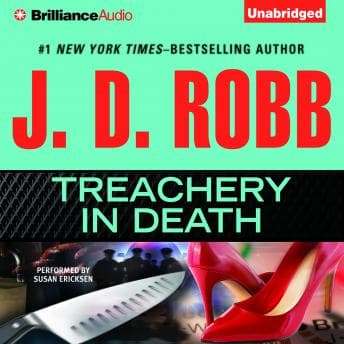
Susan Ericksen Owns This Series
Okay, so. Susan Ericksen. I need to talk about her.
There's a reason listeners say she's "the first reason I fell in love with this series." After 48 books, she doesn't just voice these characters—she inhabits them. She brings that same depth to Ceremony in Death, where the emotional stakes are just as high. Eve's gruff impatience, Roarke's Irish lilt, the way she shifts between street-level interrogations and high-society scenes. It's all there, fully realized.
Research actually shows that consistent narration across a long series creates a kind of parasocial relationship with listeners. We're not just hearing a story; we're returning to familiar voices. Ericksen understands this. Her performance "vibrates with energy," as one listener put it, and I felt that. The emotional beats land because she's earned our trust over decades of narration.
That said—and I'm being honest here—some listeners found the pacing slow. I noticed it too, around the middle third. There's a lot of procedural detail, a lot of interviews, a lot of Eve grinding through the investigation. If you're coming to this expecting a thriller that grabs you by the throat, you might get impatient. This is a slow burn. Robb trusts that you're invested in the characters enough to wait for the payoff.
Where Eve Goes Underground
The gang territory sequences are where the book really comes alive. That same unflinching look at damaged people making impossible choices shows up in In the Blood, though the setting couldn't be more different. Tattoo parlors, strip joints, the "ugly underground world" where everyone's made wrong turns—Robb doesn't romanticize it, but she doesn't demonize it either. These are people. Damaged, desperate, sometimes dangerous people, but people.
I found myself asking: why does Eve keep giving chances when she's seen how often people fail? The answer, I think, is in her own history. She knows what it's like to be written off. To be the kid nobody believed in. That's not sentimentality—that's psychology. We repeat patterns until we consciously break them, and Eve breaks hers by refusing to give up on others the way adults gave up on her.
The mystery itself is... fine. Honestly, it's a bit predictable if you've read enough thrillers. The pink-haired girl fleeing the scene, the gang connections, the inevitable climb up the criminal hierarchy—you can see where it's going. But that's not really why we're here, is it? We're here for Eve and Roarke. For the found family they've built. For the small moments of connection between investigations.
The Clinical Assessment
If you're already invested in this series, Connections in Death delivers exactly what you want. Susan Ericksen's narration is worth the 12-hour commitment. The character work is solid, the psychology is sound, and there's something deeply satisfying about returning to a world you know.
New to the series? Don't start here. You'll miss the accumulated weight of 47 books of relationship development. Start earlier. Let Ericksen earn your trust.
Skip this if you need fast-paced thrillers or hate procedural detail. But for longtime fans? This is comfort food. Dark, occasionally violent comfort food about murder and gang warfare, but comfort food nonetheless. Sometimes that's exactly what you need at 6 AM on a Cambridge sidewalk.