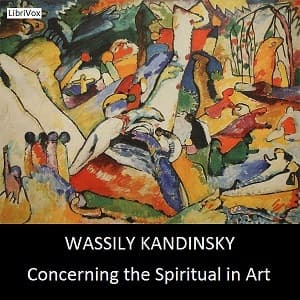

Look, I've been teaching literature for two decades. I've read enough manifestos and artistic treatises to fill a small library. So when I tell you that Kandinsky's Concerning the Spiritual in Art made me genuinely annoyed at first - and then completely won me over - you should understand that's not a contradiction. That's just how good art theory works.
Here's my complaint: Kandinsky writes like a man absolutely certain he's figured something out that the rest of us are too spiritually bankrupt to see. The pyramid metaphor? Artists at the top, leading humanity upward? My students would roll their eyes so hard they'd see their own brains. And honestly, part of me wanted to do the same.
But then something shifted.
When the Pretension Becomes Prophecy
About forty minutes in, walking the lakefront with Denise (she was listening to a true crime podcast, we do our own thing), I realized Kandinsky wasn't being arrogant. He was being desperate. This was 1911. He was watching the art world chase external success - commercial appeal, technical virtuosity for its own sake - and he was screaming into the void about something he felt was being lost.
Sound familiar? Because I give this exact speech to my juniors every semester. Different words, same panic. The soul of the thing matters more than the surface. Watership Down operates on that same principle—a story about rabbits that's really about leadership, sacrifice, and what holds a community together when everything else falls apart.
Kandinsky's writing style is dense, sure. Philosophical and theoretical in ways that require actual attention. But it's also surprisingly accessible if you let it breathe. He's not trying to exclude you - he's trying to drag you toward something he genuinely believes in. I respect that. Even when I wanted to argue with him. (Especially then, actually. The best books make you argue.)
The Voice Problem (And Why It Might Not Matter)
Now, about the narration. Expatriate delivers this in a clear, neutral, somewhat formal style. And I'll be honest - it's monotone. Some listeners have called it mechanical, and they're not wrong. There's no emotional variation, no dramatic interpretation of Kandinsky's more passionate passages.
Here's the thing, though. I'm not sure this book needs dramatic interpretation.
This isn't fiction. It's not memoir. It's art theory - the kind of text you'd encounter in a graduate seminar, read aloud by a professor who's more interested in the ideas than in performing them. The clear enunciation works. The consistent pacing works. You can actually follow Kandinsky's arguments because the narrator isn't getting in the way.
Would I have loved someone who leaned into the spiritual fervor of it all? Maybe. But I also might have found that insufferable. At 2 hours and 27 minutes, the straightforward approach kept me engaged without exhausting me. I listened to most of it while grading papers at 11 PM (don't tell Principal Martinez I wasn't paying attention to his budget emails), and the neutral delivery was actually perfect for that context.
Who Should Listen (And Who Should Skip)
If you're an art history student, this is essential listening. Period. Kandinsky basically invented abstract art, and this is him explaining why. Understanding his philosophy - the idea that color and form can express spiritual truths the way music does - changes how you see modern art. My students would hate it. I loved it.
If you're interested in the intersection of spirituality and creativity, same deal. Kandinsky draws connections between artistic expression and inner life that feel remarkably contemporary, even though he wrote this over a century ago. The man was ahead of his time in ways that still feel relevant.
But if you need dynamic narration to stay engaged? If you're looking for entertainment rather than education? Skip this one. The monotone delivery will lose you by the thirty-minute mark, and Kandinsky's theoretical density won't help.
I'd also suggest bumping the speed to 1.25x if you're finding it slow. The pacing is deliberate, which works for comprehension but can feel plodding if you're used to more energetic audiobooks.
Final Grade
This is a LibriVox recording, which means it's free and the production is clean - no background noise, no technical issues. For what it is, it's solid. The translation is faithful, the introduction is helpful, and the content is genuinely valuable if you're willing to meet it halfway.
Kandinsky believed artists had a responsibility to lead humanity toward something better. That's a heavy burden, and maybe a little presumptuous. But sitting with his words for a couple of hours, I found myself thinking about my own teaching differently. About why we still read the classics. About what gets lost when we only chase what's popular.
My 47 podcast listeners would appreciate this. My mom would fall asleep. Both reactions are valid.