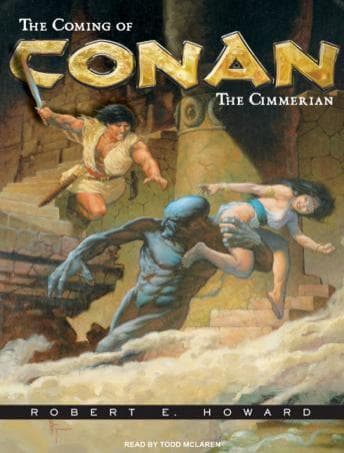

I was grading sophomore essays on The Odyssey at 11 PM—my fourth cup of coffee going cold, red pen bleeding across another paper confusing Scylla with Charybdis—when Todd McLaren's voice rumbled through my headphones with that opening invocation. "Between the years when the oceans drank Atlantis..." And suddenly I wasn't a tired English teacher anymore. I was somewhere primal. Somewhere that smelled like iron and blood and ancient sorcery.
This is why we still read the classics. Even the pulp ones.
Howard Wrote Like He Was Running Out of Time (Because He Was)
Robert E. Howard died at thirty. Thirty. He crammed an entire literary revolution into twelve years of furious writing, essentially inventing sword and sorcery while the rest of us were still figuring out our major. Reading Howard in chronological order—which this collection provides—is like watching a young genius find his voice in real time. The early stories have rougher edges. By "The Tower of the Elephant," he's hitting his stride. By "Queen of the Black Coast," he's producing work that still hasn't been matched.
My students would hate this. I love it.
The prose deserves to be savored. Howard writes with a muscular urgency that modern fantasy has largely abandoned. There's no hand-holding, no exposition dumps explaining the seventeen kingdoms and their trade agreements. Blue Cross has that same narrative confidence—you're thrown into the action and trusted to keep up. It's pulp fiction, sure, but it's pulp fiction written by someone who genuinely understood that economy of language creates power. Hemingway would've appreciated Howard's verbs.
McLaren's Conan Has a Gaelic Heart
Here's where things get interesting. Todd McLaren gives Conan an almost Gaelic accent—a choice that initially surprised me but makes perfect sense once you sit with it. Cimmeria is essentially Howard's fantasy Ireland, dark and cold and producing warriors who carry their homeland's grim poetry in their bones. McLaren's Conan sounds like a man who grew up in mist and violence. When he laughs with gusto after splitting an enemy in half, you believe it. That raw authenticity reminded me of the voices in There There—completely different setting, but the same refusal to sand down the edges for comfort. When he speaks with fire confronting sorcerers and kings, you feel the barely-contained rage of a barbarian who knows civilization is a pretty lie.
The character differentiation works well too. City watchmen get American accents—slightly jarring at first, but it creates instant class distinction. Conan sounds other, sounds dangerous, sounds like exactly the kind of man civilized people whisper about in taverns.
But—and this matters—McLaren stumbles on pronunciation. Place names get mangled. "Cimmerian" itself comes out inconsistently. For a collection this steeped in Howard's carefully constructed world, those mispronunciations can pull you out of the dream. His female voices also land somewhere between sultry and unintentionally comedic. Bêlit, the pirate queen of "Queen of the Black Coast," deserves better than occasionally sounding like she wandered in from a different production.
The narrator's voice sometimes pitches too high and light for material this dark. Howard wrote about cosmic horror before Lovecraft made it fashionable (they were correspondents, actually—there's a thesis in that friendship). When Conan faces the elephant-headed god Yag-kosha or the nameless thing in the bowl, McLaren's delivery doesn't always match the existential dread Howard was conjuring.
Eighteen Hours of Barbarian Philosophy
This is a commitment. Eighteen and a half hours of Conan hacking through thirteen stories. The pacing varies—some tales sprint, others meander through Howard's world-building. I found myself listening during faculty meetings (Principal Martinez, I was definitely paying attention to the budget discussion), on lakefront walks with Denise, during late-night grading sessions when I needed something to keep the exhaustion at bay.
It hooks you over time. The initial surprise at McLaren's choices fades as you settle into his interpretation. By the fifth or sixth story, his Conan feels right—not the Schwarzenegger version, not the comics version, but something closer to Howard's original vision of a thinking barbarian, a man who quotes poetry before killing you.
Who Should Tread These Jeweled Thrones
If you loved The Lord of the Rings audiobooks and want something leaner, meaner, and less concerned with second breakfast—this is your spiritual successor. Fantasy readers who've only encountered Conan through movies or pastiches owe it to themselves to hear Howard's original voice. The man invented a genre. That matters.
Skip this if pronunciation inconsistencies will drive you to distraction, or if you need your fantasy narrators to hit every dark note perfectly. McLaren is good—Earphones Award-winning good—but he's not flawless. And at eighteen hours, those flaws accumulate.
Worth Pausing the Faculty Meeting For
Here's the thing about Howard: he wrote like a man possessed because he was running out of time and somehow knew it. There's an urgency to these stories that no imitator has captured. McLaren's performance, despite its rough edges, honors that urgency. He understands that Conan isn't just a brute—he's a philosopher with a sword, a man who sees through civilization's pretensions because he never bought into them.
I finished the collection at 2 AM, essays still ungraded, coffee long forgotten. Denise found me staring at the ceiling, thinking about mortality and legacy and what it means to create something that outlives you by nearly a century.
That's what the classics do. Even the pulp ones.