
I was grading essays on The Great Gatsby—ironic, given what I was listening to—when the 1929 crash hit in this audiobook and I had to stop marking papers. Set down my red pen and just listened. There's something about hearing economic devastation described while you're surrounded by teenagers' interpretations of Fitzgerald that makes you feel the weight of cyclical history.
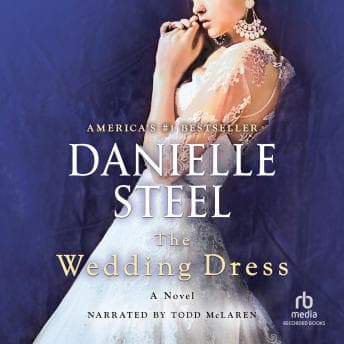
Danielle Steel isn't Fitzgerald. Let's get that out of the way. But she's doing something interesting here that I didn't expect from what I'll admit I'd mentally filed as "beach reading." Four generations of women, one wedding dress made in Paris in 1928, and the question of what we inherit beyond fabric and fortune.
The Male Gaze on Female Stories
Todd McLaren narrating a multi-generational women's saga is... a choice. An Earphones Award winner, so the man knows what he's doing. And honestly? His voice works better than I expected. When you're covering both the men who marry these women and the women themselves, having a male narrator creates this interesting distance—like you're hearing family history recounted by someone who observed it rather than lived it.
That said, his attempts at female voices occasionally pulled me out of the story. Not bad, exactly. Just odd. Like watching a skilled actor in a role that doesn't quite fit their physicality. He's good with emotional delivery—the losses of war, the drug culture of the '60s, the quiet devastation of watching fortunes crumble—but some listeners will absolutely prefer a woman's voice for this material. I get it. Denise walked by during one of the more romantic scenes and gave me a look that suggested she agreed.
Steel vs. The Classics (And I Can't Believe I'm Making This Comparison)
This reminds me of what I tell my students about saga novels—they're doing something that literary fiction often won't: they're tracking how money and class actually move through families over time. From Parisian design houses to Silicon Valley startups, Steel is mapping American wealth across a century.
If you loved Kristin Hannah's generational stories or even—and my grad school professors would revoke my degree for this—if you appreciated the family sweep of One Hundred Years of Solitude (at a much more accessible reading level), this is in that tradition. Testaments: The Sequel to The Handmaid's Tale works with similar generational weight, though Atwood's approach is far darker. The wedding dress functions like García Márquez's yellow butterflies or Faulkner's Compson land—a symbol that accumulates meaning with each generation.
Is the prose Faulkner? No. My students would actually finish this one. But the structure is ambitious, and McLaren handles the time jumps cleanly enough that I never lost track of which generation we were in.
Ten Hours of Inherited Hope
At just over ten hours, this is a commitment. Not War and Peace, but not a weekend listen either. The pacing moves like family time actually moves—sometimes decades pass in a chapter, sometimes a single wedding takes what feels like hours. (Because weddings do take hours. Denise and I eloped partly because of this.)
The book earns its length through accumulation rather than plot twists. Each generation faces their era's particular challenges—the Depression, World War II, the counterculture, the tech boom—and the dress becomes this quiet witness to how women navigate circumstances they didn't choose. It's sentimental, sure. But sentiment isn't automatically shallow.
What Steel understands, and what McLaren's steady narration emphasizes, is that family sagas work through repetition with variation. The same dress, different bodies. The same hopes, different obstacles. Worth listening at 1.0x—the rhythm of generational change needs time to land.
Who Should Listen (And Who Should Walk Away)
If you need literary pyrotechnics, skip this. If male narrators for women's stories bother you on principle, you'll be distracted the whole time. If you're looking for something to half-listen to while doing something else—maybe, but you'll miss the generational threads that make it work.
But if you want a well-constructed family saga that takes its subject seriously, if you appreciate the craft of tracking characters across decades, if you've ever wondered what your grandmother's wedding dress would say if it could talk—this is worth your time. It's comfort food, yes. But well-made comfort food.
Worth Pausing the Faculty Meeting For
I finished this during Principal Martinez's quarterly update on standardized testing metrics. (Sorry, not sorry.) Steel isn't trying to be literature with a capital L, and McLaren isn't trying to disappear into the performance. What they're both doing is telling a story about women, inheritance, and the objects that carry our hopes forward.
My students would probably hate this. Too slow, too focused on marriage and family, not enough action. But they're seventeen. Ask them again in twenty years, when they're wearing something borrowed at their own weddings, wondering what their grandmothers would think.
"The narrator was great with both genders of characters"—that's a direct quote from another listener, and I'll stand by it. Odd moments and all.