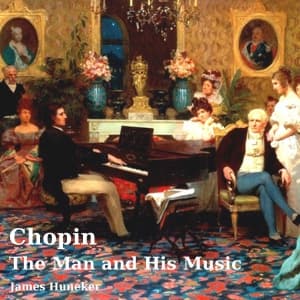

I was stress-cleaning the kitchen at midnight - Jenny was asleep, the dishwasher was running, and I had a pitch deck due at 7 AM that I was actively avoiding - when I decided to start a nine-and-a-half-hour audiobook about Frédéric Chopin written in 1900. This is what avoidance behavior looks like when you're me.
Here's the thing: I don't know much about classical music. I can tell you Chopin is the piano guy. I can hum a nocturne if you put a gun to my head. But James Huneker's book isn't really about music education. It's about obsession - specifically, one critic's absolute, borderline unhealthy obsession with another man's genius. And obsession? That I understand.
A Music Critic Who Writes Like He's Running Out of Time
Huneker trained as a concert pianist before becoming a newspaper critic, and you feel that in every sentence. This isn't some dry Wikipedia summary of Chopin's life. The man writes about piano compositions the way my mom talks about her kimchi recipe - with possessive authority and zero tolerance for disagreement. That same obsessive, almost possessive relationship with a subject - where the writer's personal fixation becomes the actual story - is what made I'll Be Gone in the Dark so hard to put down too. He'll spend twenty minutes dissecting a single étude, arguing with other critics by name (George Sand gets absolutely dragged, repeatedly), and then casually drop an opinion so sharp it feels like he's daring you to fight him.
The biographical first half covers Chopin's childhood in Warsaw, his complicated relationship with Sand, his tuberculosis, his exile in Paris. It's interesting enough, but Huneker clearly considers it table-setting. The real meal is the second half - a systematic walkthrough of Chopin's compositions, opus by opus. Mazurkas. Polonaises. Nocturnes. Ballades. He takes each form and basically writes a love letter to it while also picking fights with every other musicologist of his era.
At 2.0x speed, Huneker's prose still felt dense. The sentences are Victorian-long, loaded with French and Polish terms, and he assumes you already know who Liszt is and why his opinion on rubato matters. I didn't always. But I kept listening because Huneker's passion is genuinely infectious - the man believed Chopin was the greatest composer who ever lived, and he builds that case like a McKinsey partner builds a strategy deck. Relentless. Data-heavy. Occasionally beautiful.
LibriVox Volunteers: The Group Project Problem
Let's talk about the elephant in the room. This is a LibriVox recording, which means it's free, which means it's read by volunteers, which means you get what you pay for. Multiple readers handle different chapters, and the quality variation is... significant. Some readers clearly have experience and bring genuine warmth to Huneker's flowery prose. Others sound like they're reading a Terms of Service agreement in a closet.
There's no consistency in audio levels between chapters. One reader is practically whispering; the next sounds like they're narrating a football game. The French and Polish pronunciation varies wildly depending on who's behind the mic. Chopin's name alone gets at least three different treatments. For a book that's already challenging - Huneker references dozens of compositions, musicians, and critics, often in rapid succession - the rotating narrator situation makes it harder to find your rhythm as a listener.
I'm not going to trash free labor. These are volunteers doing public domain work, and that matters. But if you're comparing this to a professionally produced audiobook, the gap is wide.
What My Parents Would Say About This
Here's what got me, though. Huneker describes Chopin's father, Nicolas, leaving France for Poland and basically reinventing himself as a teacher and tutor. Working brutal hours. Sacrificing everything for his children's education and advancement. The parallel to every immigrant parent story I've ever known hit me at 1:30 AM while I was wiping down the stovetop.
Chopin himself was essentially a freelancer - giving private lessons to aristocrats in Paris, managing his own schedule, his own brand, his own health (badly). He was independent before "independent" was a LinkedIn buzzword. And he burned out. Died at 39. The original hustle-culture casualty.
Huneker doesn't frame it that way, obviously. He was writing in 1900. But the pattern is right there. Genius-level talent, no institutional support structure, relentless work ethic, early death. I've seen that pattern in startups. I've almost lived it.
Who This Is Actually For
If you're a classical music person who wants deep critical analysis of Chopin's catalogue, this is genuinely valuable - Huneker's musical insights have apparently held up for over a century for good reason. If you're a business person looking for biography lessons, there's maybe 90 minutes of applicable material buried in 9.5 hours. If you're someone who appreciates old-school criticism - the kind where a writer has actual opinions and isn't afraid to be wrong loudly - Huneker delivers.
But as an audiobook experience? The LibriVox production makes this a tough listen. You're fighting inconsistent audio, rotating voices, and Victorian prose density simultaneously. I'd honestly recommend reading the free Project Gutenberg text instead and putting on some Chopin in the background. You'll get more out of both.
The Consulting Recommendation
Bottom line: Huneker's writing is the real product here. Passionate, specific, occasionally brilliant criticism from a man who genuinely understood what he was analyzing. The LibriVox packaging, though, is the equivalent of delivering a great strategy presentation on napkins. Content's there. Delivery needs work. My 2.0x speed couldn't save this one from the production inconsistencies. Stream it free if you're curious, but don't spend a credit.






![Steve Jobs [unabridged audiobook] audiobook cover](/_next/image?url=https%3A%2F%2Fcovers.audiobooks.com%2Fimages%2Fcovers%2Ffull%2F9788499923406.jpg&w=1920&q=75)