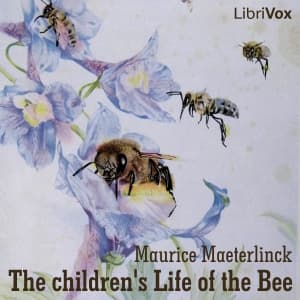

What's the last thing you'd expect to debug your brain after a week of chasing down race conditions in distributed caching? Bees. Literal honeybees.
I stumbled onto this one at 11PM on a Tuesday, too wired from a late deploy to sleep, scrolling through the free LibriVox catalog because I'd burned through my Audible credits like they were Kubernetes pods during autoscaling. Under three hours? Written by a Nobel Prize winner? About bees? Sure, why not.
A Nobel Laureate Wrote a Kids' Book About Bees and It Somehow Slaps
So here's the thing - Maurice Maeterlinck won the Nobel Prize for Literature in 1911, and apparently one of the things he did with that energy was write a dense, scholarly treatise on honeybees, then turn around and rewrite the whole thing for children. And honestly? The "children's" version is the better engineering doc. (Every senior engineer knows: if you can't explain it simply, you don't understand it well enough.)
Maeterlinck walks through the entire lifecycle of a hive - from the chaos of a swarm splitting off to found a new colony, to the deeply unsettling moment when worker bees decide to massacre the drones after mating season because they're no longer useful. He describes how scout bees communicate location data, how wax is produced and shaped into comb, how the queen is both the center of everything and weirdly powerless at the same time. It's basically a microservices architecture walkthrough, but for insects. The queen is the orchestrator, the workers are stateless processors, and the drones are... well, the drones are that legacy service nobody wants to maintain until someone finally kills it.
What surprised me is how philosophical it gets. Maeterlinck doesn't just describe bee behavior - he asks why. Why do bees sacrifice individually for the hive? What drives ten thousand tiny brains to coordinate without a central controller? He's essentially asking about emergent behavior and distributed consensus decades before anyone formalized those concepts. For a "children's book," it's sneakily deep. The only other audiobook that gave me that same feeling of stumbling into something smarter than it had any right to be was Watership Down - another animal society that turns out to be a dense meditation on politics, survival, and collective intelligence dressed up as a story for kids.
Phil Chenevert and the LibriVox Factor
Let's talk about the elephant in the room: this is a LibriVox recording. Free. Volunteer narrator. No Audible production polish, no studio mixing, no Ray Porter (obviously). Phil Chenevert reads it straight - clear, measured, no dramatic flourishes. He's not doing character voices because there aren't characters. He's reading what amounts to a Victorian-era nature essay adapted for younger readers, and he does it with the steady patience of someone who genuinely wants you to understand what's happening inside a hive.
Is it going to blow your mind sonically? No. Is it perfectly fine for what it is? Yes. There's something almost ASMR-adjacent about a calm voice explaining bee architecture at midnight when you can't sleep. The audio quality is clean enough - no weird room echo or mic pops that plague some LibriVox recordings. Chenevert clearly took care with this one.
The pacing is gentle. Almost too gentle at 1x. I bumped it to 1.5x (my default) and it hit a nice rhythm - informational without being rushed. At 2h43m, even at normal speed this is basically one round-trip commute. I finished it in a single insomniac evening.
Who Should Actually Listen to This
Perfect for: bedtime listening, background while cooking, that weird 2AM window when you're too tired to function but too wired to sleep. Skip for: anything requiring sustained attention or narrative momentum. This isn't a story. It's a lecture from 1901, softened for kids, read by a kind man.
If you're a science nerd who appreciates how people understood complex systems before we had the vocabulary for complex systems, there's genuine joy here. If you're looking for a modern pop-science audiobook with narrative arcs and dramatic reveals - this isn't that. It's a historical curiosity that happens to contain legitimately interesting entomology.
Parents: this would actually be solid for kids who are into nature stuff, though fair warning - Maeterlinck does not sugarcoat the drone massacre or the queen-killing. Nature is brutal and he's honest about it. Respect.
The ROI Equation
The ROI on this audiobook is weird to calculate because it's free. Zero cost, sub-three hours, and I learned that bees essentially invented climate control systems millions of years before HVAC existed (they fan their wings to regulate hive temperature - distributed thermostat, no central controller). That one fact alone was worth the listen.
But I can't pretend this competes with a proper Audible production. It's a LibriVox volunteer reading a public domain text from 1901. Calibrate expectations accordingly. It's a nice palate cleanser between heavier listens - I went from this straight into a Peter Watts novel and the contrast was wild.





![Steve Jobs [unabridged audiobook] audiobook cover](/_next/image?url=https%3A%2F%2Fcovers.audiobooks.com%2Fimages%2Fcovers%2Ffull%2F9788499923406.jpg&w=1920&q=75)