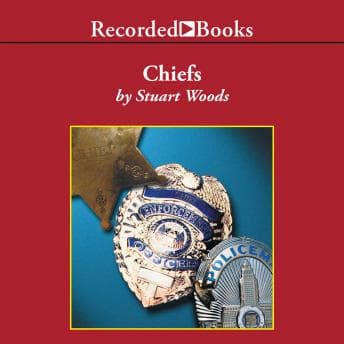

Stuart Woods' debut novel is better than ninety percent of what he wrote after it. There. I said it.
I've read a handful of his Stone Barrington books - they're fine, they're beach reads, they're the literary equivalent of hospital cafeteria coffee. Chiefs is something else entirely. This is the book that won an Edgar, and after seventeen and a half hours with Mark Hammer's voice in my car, I understand why.
Three Badges, One Town, Fifty Years of Rot
The structure here is what got me. Three police chiefs across three generations in Delano, Georgia, each one picking up the thread of young men disappearing - and each one running into the same wall of small-town silence. The first chief is honest and hardworking and gets a shotgun blast for his trouble. The second is no hero but he notices things. The third, in 1969, inherits a filing cabinet full of ghosts.
As someone who's actually worked a code, I know what it's like to walk into a situation where everyone in the room knows something is wrong and nobody wants to say it out loud. That's Delano. The whole town is a code blue that nobody's calling. The social order - the racism, the good-old-boy networks, the way power protects itself - Woods doesn't flinch from any of it. There's racist language that's period-accurate and uncomfortable, ritual violence that made me grip my steering wheel harder than necessary at 7 AM on the I-10.
And here's the thing that separates this from your average serial-killer procedural: the killer isn't really the point. The town is the point. The way a community can absorb evil into its foundation like water damage in drywall - invisible until the whole structure is compromised.
Mark Hammer Sounds Like Your Grandfather Telling You a Secret
This narrator. His Southern drawl isn't performative - it's not some actor doing "y'all" for flavor. It's the voice of a man sitting on a porch, taking his time, because the story deserves time. He's got this quality that other listeners have called "homey wisdom" and that's exactly right. The character differentiation is subtle - tone shifts rather than full-on voice acting - but it works because this isn't a book that needs theatrics. It needs honesty.
Now. The pace. I need to be straight with you: this is a slow listen. Seventeen hours and twenty-seven minutes, and Hammer is in no rush. Some mornings I'd pull into my driveway and sit there for an extra five minutes because the scene was building, and other mornings I wished he'd pick it up just a notch. If you're the type who listens at 1.5x speed, you might want to try 1.25x here. I kept it at normal speed because the drawl is part of the atmosphere, but I get why some people find it languid.
But that ending. Carlos asked why I was crying in the car. I blamed allergies. When Hammer said "The End," I just sat there in my driveway with the engine running, feeling like I'd lived in Delano for fifty years and was finally allowed to leave.
The Medical Details Are - Well, There Aren't Many
This isn't a medical thriller, so I didn't get to yell at my dashboard about defibrillator protocols. But the violence is realistic in a way that matters. The shotgun blast that kills the first chief isn't glorified or sanitized. The missing persons cases feel like real cold cases - messy, incomplete, frustrating. Woods based this on his own grandfather's story (his grandfather was a chief of police who was shot in the line of duty), and that personal connection shows. This isn't research. This is inheritance.
Compared to most modern thrillers that try to pack twelve plot twists into three hundred pages, Chiefs trusts you to sit with discomfort. It trusts the slow accumulation of dread. It's the difference between a jump scare and that feeling when you walk into a patient's room and something is just off before you even check vitals. Pieces of Her gave me that same slow-building dread, where you know something's wrong long before the characters do.
Who Needs This in Their Ears
If you want fast-paced, chapter-ending cliffhangers every twenty minutes - skip this. If you want a slow-burn mystery that's really about how a place shapes its people and how silence becomes complicity, this is night shift approved. Perfect for long commutes or road trips where you've got the mental space to let a story breathe. Not background listening - you need to pay attention or you'll miss the quiet moments where everything shifts.
My mom would love this (she still thinks I should've been a doctor). It's got that multigenerational family saga quality she gravitates toward, wrapped in a mystery that doesn't insult your intelligence.
Seventeen hours well spent. And that almost never happens.