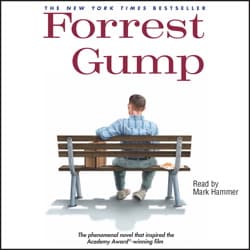

Winston Groom's Forrest Gump is not the book you think it is. If you've seen the movie — and statistically, you have — you need to forget about ninety percent of it before you press play.
I started this one during a Sunday lakefront walk with Denise, and within the first hour she was giving me that look because I kept stopping to say things like "Wait, he goes to SPACE?" and "There's an APE?" She eventually walked ahead. I don't blame her.
The Book Tom Hanks Never Made
Let's talk about what the author is really saying. Because Groom's Forrest is not the saintly, gentle soul Robert Zemeckis gave us. This Forrest is crude, sexual, oddly mathematical, and the prose — written in Forrest's own fractured dialect — reads like Huckleberry Finn's rougher cousin got drafted. The misspellings are intentional. The grammar is intentionally busted. And the story is wilder, meaner, and frankly funnier than the sanitized Hollywood version.
Forrest becomes an astronaut. He crash-lands with an orangutan named Sue. He plays chess hustles. He becomes a professional wrestler called "The Dunce." He grows marijuana. None of this made the film, and honestly? Some of it probably shouldn't have. But Groom was writing satire, not sentiment. He was using an idiot savant to hold a funhouse mirror up to three decades of American absurdity — Vietnam, Watergate, the counterculture, corporate greed — and the reflection is deliberately distorted and uncomfortable. Piranha does something structurally similar — uses genre absurdity as cover for a sharper critique than the premise has any business delivering. Forrest Gump itself, of course, only became a classic by accident — when Hollywood got hold of it.
The novel's ending is different too. Darker. More ambiguous. Some listeners hate this — they want the bench, the chocolates, the reunion. And I get it. But Groom wasn't writing a love story. He was writing a picaresque, and picaresques don't end with neat bows. They just... stop. If you loved Catch-22, this is its spiritual successor in ways the movie never let on.
Mark Hammer and the Missing Drawl
Here's where it gets complicated. Mark Hammer narrates this audiobook, and opinions on his performance are split right down the middle like a faculty vote on dress code policy. Some listeners call him phenomenal. Others say — and I'm quoting here — he "sucks all the life out of the story."
I land somewhere in between, leaning generous. Hammer keeps Forrest's voice consistent across nine hours, which is harder than it sounds when you're sustaining a character who narrates in broken English the entire time. He differentiates characters without doing full theatrical voice changes — you always know who's speaking, even if the distinctions are subtle. His comedic timing lands more often than it doesn't.
But — and this is a real but — he doesn't sound Southern. At all. And for a book written entirely in a deep Alabama dialect, where Forrest says things like "let me say this: bein a idiot is no box of chocolates," the absence of any drawl is disorienting. It's like hearing someone read Trainspotting in received pronunciation. The words are right but the music is wrong. Hammer does pace himself well through the more reflective passages. But the voice itself? It sits at a strange distance from the material.
I listened at 1.0x — because the author chose those words and that dialect for a reason — and at that speed, Hammer's delivery works well enough. But I kept imagining what this would sound like with a narrator who actually inhabited the geography of the character. A Billy Bob Thornton type. Someone who could make you taste red clay.
Who Should Press Play (And Who Should Just Rewatch the Movie)
If you've only ever known the movie and you want to understand what Groom actually wrote — yes, listen to this. It's a genuinely different experience. Funnier, stranger, less sentimental, more satirical. Forrest really does go to space, and no, the ape is not a metaphor. The book has a shaggy, episodic energy that rewards patience, and at nine hours it doesn't overstay its welcome.
But if you're expecting Hanks-era warmth and you're particular about Southern authenticity in narration, you might bounce off this hard. The narrator situation is a coin flip — you'll either adapt to Hammer's interpretation or it'll grate on you for the full runtime. There's no middle ground based on what I've heard from other listeners.
Worth the nine hours? The book, absolutely. The narration is its own gamble, but even a coin-flip read beats the budget presentation — Principal Martinez, if you're reading this, I skipped that meeting to find out how the space program worked out for Forrest.
The Assignment I'd Actually Give
Groom wrote a book about an idiot who stumbles through history and accidentally reveals how idiotic history already is. That's a better premise than the movie ever let it be. The audiobook doesn't fully serve the material — the missing Southern voice is a genuine loss — but Hammer's consistency and the sheer weirdness of the source text carry it far enough. Read it to understand what got lost in translation. Listen to it because nine hours with Forrest Gump, the real one, is still a pretty good walk along the lakefront. Even if Denise does leave you behind.