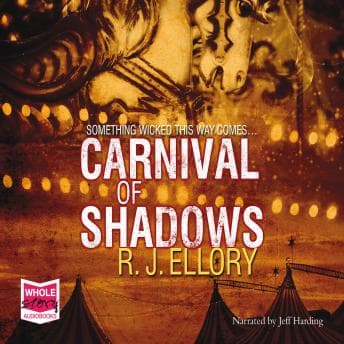

Look, I need to rant about something before we get into this. Twenty hours and thirty minutes. That's what R.J. Ellory is asking of you here. And for roughly the first ten of those hours, I kept muttering to Shirley (my cat, not Jackson, though Jackson would've had opinions about this book's pacing too) — I kept saying, "When is this going to become the horror-adjacent carnival nightmare I signed up for?" Because the setup. The setup is glacial.
But here's the thing about me: I'm a librarian. I've sat through 800-page gothic novels where nothing happens until page 400 and then your entire worldview collapses. Patience is literally my profession. So I stuck with it.
The Carousel Turns Slow Before It Kills You
Kansas, 1959. A carnival rolls into a small town like something out of a Bradbury fever dream — except Ellory isn't interested in Bradbury's poetic sprint. He wants to marinate you in the mundane first. Agent Michael Travis gets sent to investigate a body found beneath the carousel, and what should be a tight FBI procedural becomes this sprawling, digressive character study that loops back through Travis's childhood, his teenage years, his entire emotional biography. Some of these flashback sequences — particularly the ones covering Travis's adolescent losses — hit with genuine devastation. I was shelving returns at the library during my lunch break, earbuds in, and I had to stop and pretend I was reading a spine label because my eyes were doing something embarrassing.
The carnival characters themselves are genuinely well-drawn. The performers, the illusionists, the whole traveling community — Ellory writes them with this strange warmth that makes you trust them even when the narrative is telling you not to. That tension between the reader's instinct and the author's framing? That's good horror-adjacent craft. Shirley Jackson walked so this kind of atmospheric unease could exist, even if Ellory takes a scenic detour through three counties to get there.
Where the Tent Poles Buckle
Here's where I get frustrated, and I say this as someone who has defended slow-burn horror on my podcast for 200-plus episodes: the second half loses structural coherence. The conspiracy elements that emerge feel like they belong in a different book — a paranoid thriller that hasn't earned its paranoia yet. Travis's investigation starts bending toward something that defies comprehension (the book's words, not mine), and Ellory asks you to make a leap of faith that the first half's methodical realism hasn't prepared you for. Wild Sheep Chase pulls a similar bait-and-switch on you — methodical and grounded right up until reality quietly exits the building — but Murakami earns the surreal pivot in a way Ellory doesn't quite manage here. It's like spending ten hours building a house and then asking the audience to accept that the house can fly.
I listened to the back half during a late shift at the branch, alone in the building after closing, which should have been perfect — empty library, dark parking lot outside, a story about inexplicable things happening in small-town America. The atmosphere was right there. But I kept rewinding because the narrative threads got tangled in ways that felt unintentional rather than deliberately disorienting. There's a difference between "I'm confused because the author is building toward a revelation" and "I'm confused because the connective tissue between plot points has dissolved." This was mostly the latter.
Jeff Harding Does What He Can
Harding's narration is steady. Professional. He handles the long descriptive passages without making them feel like punishment, which is no small feat given how dense some of Ellory's prose gets. But I wouldn't say the performance elevated the material in the way the best narrator work does. The carnival characters needed more vocal texture — more grit, more strangeness, more of that unsettling otherness that makes you feel like these people exist slightly outside normal reality. Harding keeps everything at a consistent register, which serves the procedural elements fine but flattens the supernatural edges. The narrator commits to competence. I wanted him to commit to weirdness.
At 1.0x speed, this thing drags. I bumped to 1.25x around hour six and didn't lose anything. If anything, it helped the pacing feel closer to what the story probably deserved.
Who Gets a Ticket to This Carnival
If you're an Ellory completist, you'll find things to love here — the man can write characters that feel like people you've actually met, and Travis is a genuinely affecting protagonist. If you're coming for horror, temper your expectations. This is a mystery with supernatural seasoning, not the other way around. If you need tight plotting and a second half that matches the promise of the first, you might end up where some listeners did: staring at the ceiling wondering what just happened.
My podcast listeners are going to have mixed feelings about this one, and honestly? So do I. There are passages in Travis's backstory that wrecked me. There are structural choices in the back half that lost me. It's a twenty-hour commitment that rewards patience in some places and tests it mercilessly in others.
Closing the Library on This One
I wanted to love it. A 1959 carnival, a body under the carousel, an FBI agent whose faith gets dismantled — that's my exact frequency. But wanting something to be great and it actually being great are different things, and Carnival of Shadows lives in the gap between ambition and execution. Worth your time if you're willing to meet it more than halfway. Just maybe not worth your credit.