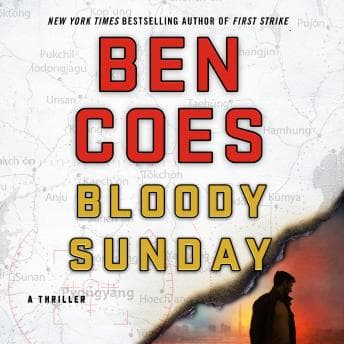

Look, I'll be honest — political thrillers aren't my usual hunting ground. I live in the space where dread creeps under the door, not where it kicks the door down with a tactical boot. But I was shelving books at the library last Tuesday, came across three different Ben Coes novels in the returns bin, and figured the universe was telling me something. So I downloaded Bloody Sunday, threw on my headphones for the drive home, and then — this is the embarrassing part — sat in my parking lot for forty minutes because I couldn't turn it off.
So here we are.
The Dewey Andreas Problem (It's Not What You Think)
I expected a generic action hero. Square jaw, few words, punches things. And yeah, Dewey Andreas is built from that mold — but Coes does something sneaky with this installment that caught me off guard. The poison mechanic. Dewey accidentally injects himself with a designer toxin and now has less than 24 hours to get into North Korea, find the antidote, AND dismantle a nuclear exchange between Pyongyang and Tehran. It's absurd. It knows it's absurd. And the ticking clock works precisely because the stakes are simultaneously global and deeply personal — this guy isn't just saving the world, he's trying not to die from his own mission's weapon.
What surprised me is how the geopolitical scaffolding actually holds up. The Iran-North Korea deal — nukes for missiles, mutual escalation — feels uncomfortably plausible. Coes was a speechwriter for George H.W. Bush, and you can feel that background in the way the political machinery moves. The intelligence briefings, the backroom negotiations, the way decisions cascade through bureaucratic chains before Dewey gets to do his thing. It's not just "hero goes boom." There's infrastructure here.
That said, this is the eighth book in the series, and there are moments where the writing assumes you already care about certain characters and relationships. I didn't feel lost — Coes gives you enough context — but I could tell there were emotional beats landing harder for longtime readers. A newcomer tax, basically. You can afford it, but you'll notice you're paying it.
Ari Fliakos Understands the Assignment
The narrator commits. That's rare.
Fliakos voices Dewey with this simmering anger that sits just below the surface of every line, even the quiet ones. It's not yelling — it's restraint that makes you believe this is a man holding himself together by sheer force of will while poison works through his bloodstream. When the action scenes hit, Fliakos doesn't suddenly shift into breathless panic mode. He stays controlled, almost clinical, which paradoxically makes the violence feel more intense. Like a surgeon narrating his own emergency.
His accent work is solid too — shifting between American intelligence operatives, Korean officials, and Iranian contacts without it ever feeling like a caricature. There's a distinction in cadence and tone between the different national players that creates instant identification. You always know who's talking, even when Coes is cutting rapidly between locations and perspectives.
I've listened to a lot of thriller narrators who mistake "dramatic" for "loud." Fliakos gets that drama lives in the pauses, in the way a sentence lands when you let the silence after it do the work. This performance won an AudioFile Earphones Award, and yeah — I get it.
Who Needs This in Their Ears
If you're a Brad Thor or Vince Flynn person, you probably already know about Dewey Andreas. If you don't — start here. The poison-antidote thread gives this enough standalone momentum that you won't feel adrift, and Fliakos's performance makes the case for audio over print pretty convincingly.
If you're like me and live in horror/suspense territory, this scratches a different itch but scratches it well. The 24-hour countdown creates genuine tension — not existential dread, but that kinetic, will-he-make-it propulsion that kept me in my car like an idiot.
Skip if you need deep character interiority or if military/espionage jargon makes your eyes glaze over. This book knows what it is and doesn't apologize for it. That same unapologetic momentum — a story that commits fully to its own genre mechanics without blinking — is something I found in Dead Men's Money too, though the stakes there are considerably more street-level than nuclear.
Shirley (My Cat) Was Unimpressed. I Was Wired.
I finished this at 11 PM on a work night. Didn't scare me — but my heart rate was definitely elevated for the last two hours in a way that made sleep... complicated. It's not horror, it's not my genre, and I'm still recommending it. That should tell you something. Coes writes propulsive action with enough geopolitical backbone to feel earned, and Fliakos turns it into something you experience rather than just hear. My podcast listeners are going to raise their eyebrows at this one showing up in my feed, but good craft is good craft regardless of genre.
Worth the credit. Don't even hesitate.