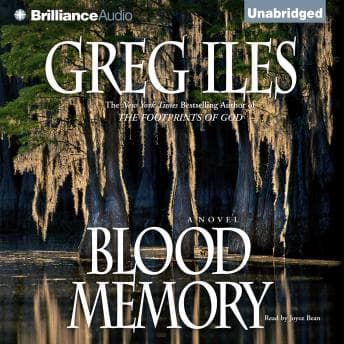

Most people seem to approach Blood Memory for the serial killer plot. And sure, that's there — bite marks, forensic odontology, New Orleans murder scenes. But I finished this nearly nineteen-hour audiobook at 1 AM while seasoning a lamb rogan josh I had no business making on a Tuesday, and the thing that kept me standing at my stove instead of going to bed wasn't the whodunit. It was Catherine Ferry's psychology.
Cat is a forensic odontologist who's also an alcoholic, sleeping with her married colleague, and — here's the kicker — completely dissociated from her own childhood trauma. The protagonist exhibits classic compartmentalization so textbook it almost reads like a case study from my Psych 640 seminar. She can stare at a mutilated corpse and catalog dental impressions with clinical precision, but the moment her own body starts sending distress signals — panic attacks at crime scenes, blackouts over victims — she has zero framework for processing it. The research actually shows that professionals in forensic and trauma-adjacent fields often develop this exact split: hypercompetent in their domain, catastrophically avoidant in their personal lives. Iles gets this right. Disturbingly right.
When the Crime Scene Is Inside Your Own Head
What makes Cat compelling is that she's not just unreliable — she's unreliable to herself. The book is written in first person present tense, which I know some listeners hated, but psychologically? It's the correct choice. Cat doesn't have the luxury of retrospective narration because she literally cannot access her own past. She's constructing her identity in real time, which is exactly what happens in dissociative responses to childhood sexual abuse. When she returns to her family's antebellum estate in Natchez and forensic chemicals reveal bloody footprints in her childhood bedroom — footprints that contradict everything she believed about her father's murder — it's not just a plot twist. It's the moment her narrative self starts cracking open.
I found myself asking: why does Cat really keep returning to crime scenes that trigger her? The book frames it as professional dedication, but the psychology underneath is compulsion repetition. She's reenacting proximity to violence because it's the only context where her buried memories have permission to surface. My therapist would have thoughts about this character. Many thoughts. Expensive thoughts.
The dual mystery structure — present-day serial killings in New Orleans intertwined with a decades-old family murder — works because both cases are really about the same thing: what happens when memory is weaponized. Cat's family has constructed an entire mythology around her father's death, and watching her dismantle it with the same forensic tools she uses on strangers is genuinely unsettling. Iles understands that the scariest thing isn't a killer — it's discovering that the people who were supposed to protect you were the ones who needed forensic investigation.
Joyce Bean Does the Heavy Lifting (Mostly)
Joyce Bean's narration carries this book through its considerable length. Her voice for Cat hits the right register — fragile but sharp, like someone holding herself together with professional jargon and white-knuckle control. She differentiates male characters convincingly enough that I never lost track of who was speaking, and her male voices actually sound male, which — you'd be surprised how often narrators fumble this.
But. There's the detective. Sean Regan, Cat's married lover and homicide detective, has this accent that I can only describe as... geographically confused? It's supposed to be New Orleans, I think, but it wanders somewhere between Boston and a BBC period drama. Every time he spoke, I got pulled out of the scene. In a book that runs nearly nineteen hours, that's a lot of pulling. It's not a dealbreaker, but in a story where you need to trust the intimacy between Cat and her lover, the accent creates an odd distance.
The first-person present tense narration is polarizing and I get why. It creates immediacy — you're inside Cat's fractured consciousness as events unfold — but over nineteen hours, it can feel relentless. There's no breathing room. No past-tense reflection to soften the edges. For me, that intensity worked because it mirrors Cat's psychological state: she can't step back, so neither can you.
Who Should Clear Their Schedule (And Who Shouldn't)
This is a book for people who want their thrillers to actually understand trauma instead of using it as window dressing. If you've read enough psychology to recognize dissociation, repressed memory, and intergenerational abuse patterns, you'll find Iles surprisingly literate on these subjects. The bar for thrillers that actually do this work is low enough that I keep a mental shortlist — 20th Victim gets psychological texture right in a way that most procedurals don't even attempt, though it's operating in a very different register than what Iles is doing here. If you want a fast, clean procedural — this isn't it. The pacing drags in the middle third when Cat is in Natchez piecing together family history, and the plot requires you to hold multiple timelines and character relationships in your head simultaneously.
Content warning that matters: this book deals explicitly with childhood sexual abuse. Not gratuitously, but unflinchingly. If that's a hard boundary for you, respect it.
The Case File Stays Open
Psychologically, this tracks. Almost everything Cat does — the drinking, the affair, the forensic obsession, the eventual confrontation with family secrets — follows a pattern I've seen in clinical literature on adult survivors of childhood trauma. Greg Iles didn't just write a thriller with a damaged protagonist. He wrote a character whose damage is the mystery. That's rare. That's the thing that kept me stirring lamb at 1 AM instead of being a functional adult.
Is it perfect? No. It's too long by about three hours, the detective's accent is a genuine distraction, and some of the Southern Gothic family revelations veer toward melodrama. But the psychological architecture holds. And in this genre, that's what I'm grading on.