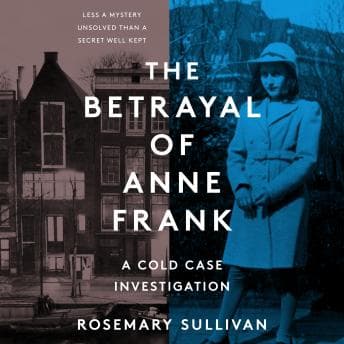

Let me cut to the chase: this book made me angry. Not at the Nazis—that's a given—but at the cold case team's conclusion, which has since been disputed by historians and even retracted by the Dutch publisher. I finished this one during a late-night security audit at a client's facility, Ranger snoring at my feet, and I kept muttering "that's not how evidence works" at my phone.
Here's the thing. The investigation itself? Fascinating. Retired FBI agent Vincent Pankoke and his team used modern law enforcement techniques—probability matrices, timeline analysis, the kind of methodical grunt work I respect—to chase down a seventy-year-old mystery. Sullivan does excellent work walking you through wartime Amsterdam, the impossible choices people faced, the way the Nazi occupation turned neighbors into informants and informants into ghosts. The sections on how the Frank family survived undetected for over two years are genuinely gripping. You understand the constant fear, the dependency on helpers who risked execution, the fragile web of trust that kept eight people alive in an attic.
When the Intel Goes Sideways
But here's where it lost me. The team's ultimate conclusion—that a Jewish notary named Arnold van den Bergh betrayed the Franks to save his own family—rests on circumstantial evidence that wouldn't survive a preliminary hearing, let alone a court martial. An anonymous note. Circumstantial timing. A lot of "could haves" dressed up as "probablys." I've seen this scenario play out in real life: you get so deep into an investigation, so desperate for a resolution, that you start seeing patterns that aren't there. The Dutch historians who tore this apart weren't being pedantic—they found genuine holes in the methodology.
Sullivan, to her credit, presents the investigation with appropriate caveats. She's not claiming absolute proof. But the marketing around this book—"finally solved"—oversells what the evidence actually supports. That disconnect bothered me throughout.
Julia Whelan Carries the Mission
Julia Whelan's narration is what kept me listening past my frustrations. She handles the Dutch names and locations with care, never stumbling over "Prinsengracht" or the various German titles. Her pacing matches the investigative rhythm—measured during the document analysis, more urgent during the breakthrough moments. Some listeners found her delivery dry, and I get that. This isn't a thriller performance. It's the voice of someone reading a meticulous case file aloud, which is exactly what the material demands.
The 10-hour runtime feels appropriate. Dense? Yes. But you're covering decades of history, multiple investigative threads, and the lives of dozens of people who intersected with the Frank family. I'd recommend normal speed here—1.25x lost some of the nuance in the historical sections, and I found myself rewinding more than usual.
The History That Holds
Strip away the controversial conclusion, and there's still real value here. Sullivan's portrait of occupied Amsterdam—the food shortages, the round-ups, the way ordinary bureaucracy became a weapon—is worth the listen alone. The sections on the helpers who protected the Franks, particularly Miep Gies and Johannes Kleiman, reminded me why I believe in individual courage even when systems fail. That same moral clarity under pressure shows up in Cruel and Unusual, where ordinary people face impossible choices in a broken system. These weren't soldiers. They were office workers who chose to risk everything.
The book also does something important: it refuses to let the betrayal remain abstract. Someone made a phone call or wrote a note or whispered to the wrong person. The Franks weren't discovered by accident. That deliberate human choice—whether it was van den Bergh or someone else entirely—is what makes this story so haunting.
Mission Debrief
If you're a history buff or true crime listener who can appreciate the investigation while holding its conclusions at arm's length, this is worth your time. If you're looking for definitive answers about who betrayed Anne Frank, you'll finish frustrated—because the truth is, we still don't know for certain.
Skip this if you need a clean resolution. The journey here is more valuable than the destination, and that's either a feature or a bug depending on what you're after.
Ranger stayed awake for the whole thing, which is more than I can say for most of my audiobooks. Take that as you will.