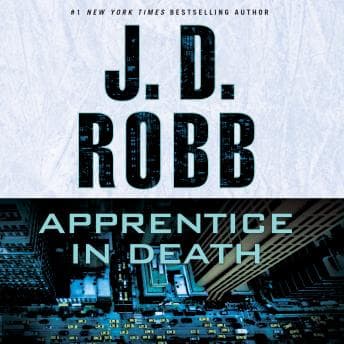
"Someone is being trained by an expert in the science of killing."
That line hit me around the two-hour mark, and I actually said out loud in my car: "Oh, this is going to be bad." Not bad as in poorly written. Bad as in the kind of case that makes you grateful you work in a hospital where the violence has already happened by the time patients reach you.
Look, I've been listening to the In Death series for years now. It's my post-night-shift ritual. Carlos knows that when I pull into the driveway and don't immediately come inside, I'm probably finishing a chapter. Or crying. Or yelling about procedural inaccuracies. With Apprentice in Death, it was mostly the first two.
The Case That Actually Made Me Check My Mirrors
Sniper attacks in Central Park. Three random victims—a young skater, a doctor, a teacher. And here's what J.D. Robb (yes, I know it's Nora Roberts, we all know) does so well: she makes you feel the randomness. The terror of it. These weren't targeted kills in the traditional sense. They were practice.
Practice.
I've worked trauma. I've seen what bullets do to bodies. The clinical descriptions in this book? Pretty accurate, actually. The chaos of multiple GSW victims arriving simultaneously? Yeah, that tracks. The way first responders compartmentalize while their hands are shaking? Robb gets it. She gets the adrenaline and the aftermath.
The twist—that there are TWO shooters, one training the other—is genuinely chilling. Because we've all met people like this. Not killers, necessarily, but people who pass down their damage like an inheritance. The psychology here isn't Hollywood nonsense. It's the kind of thing I've seen play out in different ways on my unit. Generational trauma with a tactical scope.
Susan Ericksen Has Been Eve Dallas Longer Than Some Marriages Last
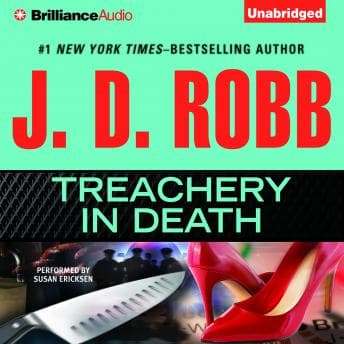
Here's the thing about Susan Ericksen. She's been narrating this series for what, forty-something books? At this point, she IS these characters. When she does Roarke's Irish lilt, I don't think "oh, the narrator is doing an accent." I think "Roarke is talking." When Eve gets that cold edge in her voice during interrogation? Chills. Every time.
The emotional delivery in this one is particularly strong. There's a scene—I won't spoil it—where Eve has to deliver news to a victim's family. Ericksen's voice just... breaks a little. In exactly the right way. The way real people break when they're trying to hold it together professionally.
Now. I have to address the elephant in the room. Apparently she mispronounces "Corpsman" as "Corpse-man" at some point. I'll be honest, I didn't catch it—I was probably too busy merging onto the 10 at 6 AM with my brain running on caffeine and spite. But I've seen other reviewers mention it, and yeah, that would bug me if I'd noticed. It's a small thing in thirteen hours of otherwise excellent narration, but I get why military folks would wince.
Who's Going to Love This (And Who Should Skip)
If you're already invested in the In Death series, this is a solid entry. Not my absolute favorite (that honor goes to a few earlier books), but it's tight, it's tense, and the relationship between Eve and Roarke continues to be the emotional anchor that keeps this series from feeling formulaic.
New to the series? Don't start here. You CAN, technically. Robb does enough backstory weaving that you won't be completely lost. But you'll miss so much context—the weight of Eve's trauma, the evolution of her marriage, the way her team has become family. Start earlier. Thank me later. If you want another series entry that stands strong on its own, Ceremony in Death gave me that same tight plotting without requiring forty books of context.
Fair warning: there's some explicit content. The romance scenes between Eve and Roarke are... detailed. I'm not bothered by it—Carlos and I have been married seventeen years, I've seen things—but if that's not your jam, skip ahead. Also some language and violence, obviously. It's a murder investigation in 2061 New York. Nobody's saying "gosh darn."
Clocking Out
I finished this one on a Tuesday morning, sitting in my driveway while the sun came up. The ending hit harder than I expected. Not because of the resolution—you know Eve's going to catch them, that's not a spoiler, that's the genre—but because of what it says about the people who make killers. The ones who shape children into weapons.
Carlos asked why I was sitting in the car so long. I blamed allergies.
Thirteen hours went by faster than some eight-hour shifts. Susan Ericksen remains a national treasure. And somewhere around hour ten, I realized I'd been white-knuckling my steering wheel during a scene that took place entirely in a conference room.
That's good audiobook making. That's the In Death series doing what it does best.
Night shift approved.