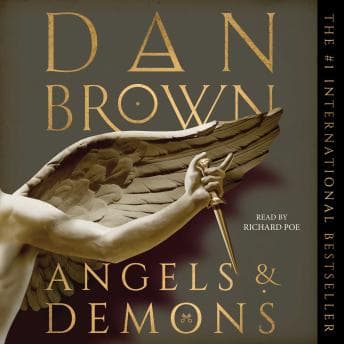

Look, I have a complicated relationship with Dan Brown. As someone who studies why people do terrible things to each other, I should appreciate his villains. And I do—sort of. But the psychologist in me also notices when character motivations are held together with duct tape and wishful thinking. That said, Angels & Demons? It's a ride. A ridiculous, breathless, utterly addictive ride that I listened to while cooking increasingly elaborate curries I'd eat alone at midnight.
The Case Study of Robert Langdon
Here's the thing about Robert Langdon as a protagonist: he's basically a walking Wikipedia article with a Mickey Mouse watch and a fear of enclosed spaces. Psychologically, this doesn't track as deeply as I'd like—his phobia conveniently appears and disappears based on plot requirements. But you know what? I don't care. Brown understands something fundamental about human nature: we love feeling smart. Every time Langdon decodes a symbol or explains Bernini's architectural choices, we get to feel like we're the clever ones figuring it out.
The Illuminati as villains tap into something primal—our fear of hidden power structures, of being manipulated by forces we can't see. The research actually shows that conspiracy theories appeal to people who feel a lack of control in their lives. Brown exploits this brilliantly. Is it cheap? Maybe. Does it work? Absolutely.
Vittoria Vetra is... fine. She's the Beautiful Scientist trope personified, which my feminist academic brain wants to critique more harshly. But she's also competent and drives significant plot points, so I'll give her a B-minus on the character complexity scale. (Don't tell my students I grade fictional characters. They'd never let me hear the end of it.)
Speaking of character complexity, Poe also narrates Deception Point, where Brown's protagonist gets a bit more psychological depth—though still not enough to satisfy my case-study brain.
Richard Poe Nails the Panic
Richard Poe's narration won an AudioFile Earphones Award, and honestly? Deserved. The man understands pacing. Every chapter ends on a cliffhanger—that's Brown's signature move—and Poe leans into it without making it feel melodramatic. His Langdon is appropriately professorial but capable of conveying genuine terror when the antimatter countdown starts ticking.
His character voices are distinctive enough that I never got confused about who was speaking, which sounds like a low bar but you'd be surprised how many narrators fail it. The Camerlengo, in particular, gets this earnest, slightly unhinged quality that works beautifully for the character's arc.
Now. The Italian. I need to address this because several listeners apparently found it offensive, and as someone whose mother still corrects my Hindi pronunciation at family dinners, I get it. Poe's Italian is... not great. It's the kind of Italian you'd expect from someone who learned it phonetically from a pronunciation guide. For a book set almost entirely in Rome, featuring Italian characters and Latin phrases, this is a legitimate criticism. It pulled me out of the story a few times, which is annoying when you're otherwise fully immersed.
There's also occasional mouth sounds—lip smacking, that sort of thing. Minor, but noticeable if you're wearing good headphones. I was jogging through Cambridge and barely noticed, but if you're the type who gets distracted by production imperfections, fair warning.
Why This Works (Despite Everything)
I found myself asking: why does this book work when it probably shouldn't? The plot is preposterous. The timeline is impossible—Langdon accomplishes in one night what would take actual scholars months. The science is questionable at best. And yet.
Brown does something clever. He structures the book like a video game—each location is a level, each symbol is a puzzle, and there's always a ticking clock. This bypasses critical thinking through sheer momentum. You don't have time to question whether the Illuminati would really leave a trail of breadcrumbs through Rome's churches because OH GOD THE CARDINAL IS ABOUT TO DIE.
Langdon exhibits classic problem-solving patterns that feel satisfying even when they're unrealistic. He sees a clue, makes a connection, and boom—we're racing to the next location. It's dopamine engineering disguised as historical fiction.
Eighteen Hours of Vatican Chaos
At 18 hours and 34 minutes, this is a substantial listen. I spread it across two weeks of morning jogs and evening cooking sessions. The pacing is relentless enough that it never dragged, though I'll admit some of the scientific exposition in the early chapters tested my patience. Once we get to Rome, though? Pure momentum.
This is perfect commute material. Perfect "I need to stay awake on a long drive" material. It's not going to make you a better person or teach you much that's actually accurate about the Vatican, but it will entertain you thoroughly.
Who's In, Who's Out
If you want a smart-feeling, fast-paced adventure that'll make your morning commute disappear, Poe's narration delivers. Skip it if you're sensitive to religious themes being treated as thriller fodder, or if imperfect Italian pronunciation will ruin your immersion.
Brown's Inferno gives you that same breathless momentum, though I found the villain's motivations slightly more coherent from a psychological standpoint—which isn't saying much, honestly.
Case Closed (For Now)
My therapist would have thoughts about how much I enjoyed a book with this much violence and conspiracy. But that's a session for another day.