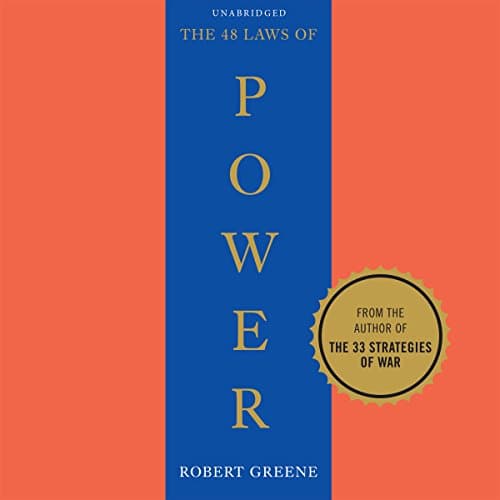

"Conceal your intentions. Use selective honesty and generosity to disarm your victim." Somewhere around the two-hour mark, Richard Poe delivers that line with the gravity of a judge reading a sentence, and I remember thinking: this book is not messing around.
I first listened to The 48 Laws of Power during a string of long commutes, and Robert Greene's landmark work hit differently in audio than it ever did on the page. Each law arrives like a self-contained lecture — a bold principle stated upfront, followed by historical anecdotes spanning centuries, from the court intrigues of Louis XIV to the cunning of con artists and warlords. Greene pulls from Machiavelli, Sun Tzu, Clausewitz, and dozens of other strategists to build what amounts to a 23-hour crash course in how power actually operates when nobody's pretending to be nice about it. I've seen that same unsentimental view of how power moves through institutions in Fourth Turning Is Here — different framework, same willingness to look at historical cycles without flinching.
Let's talk about Richard Poe's narration, because this is where listeners diverge sharply. Poe has a deep, authoritative voice — the kind of voice you'd cast as a narrator for a documentary about empires falling. His delivery is measured, deliberate, and treats the material with the seriousness Greene intended. When he moves through the historical examples — the rise of Bismarck, the manipulations of Cardinal Richelieu — his steady cadence gives the stories an almost cinematic weight. He won multiple AudioFile Earphones Awards for good reason; the man knows how to command a room through a microphone.
But here's the honest truth: that same steadiness becomes a double-edged sword over 23 hours. Some stretches feel like attending a very good university lecture that happens to run three hours too long. Poe doesn't modulate much between characters or shift energy dramatically between laws. If you're listening during a workout or a focused commute, this works beautifully — the consistency keeps you locked in. If you're trying to absorb this while half-asleep or doing mindless chores, his baritone becomes a lullaby. I caught myself drifting during a few of the longer historical digressions and had to rewind more than once. This isn't a narration problem so much as a format challenge: the book itself is dense, encyclopedic, and structured more like 48 essays than a flowing narrative.
The content, though? It's earned its reputation as a multi-million-copy bestseller for a reason. Greene doesn't moralize. He presents power dynamics the way a biologist presents predator-prey relationships — here's how it works, here's what happens when you ignore it. Some laws feel immediately practical ("Never outshine the master," "Say less than necessary"), while others read more like warnings about what to watch for in others ("Crush your enemy totally" is not exactly advice for your next team meeting). The historical examples are where the audiobook genuinely shines. Greene is a gifted storyteller when he's narrating the downfall of a Renaissance duke or the chess match between rival generals. Those stories stick with you.
What makes this audiobook worth the time investment — and it is an investment — is the cumulative effect. No single law is revolutionary on its own. But after absorbing 48 of them, illustrated by hundreds of historical examples, you start seeing patterns in your own life. The colleague who takes credit for your work. The boss who keeps you just uncertain enough to stay loyal. The friend who uses generosity as leverage. Greene's framework gives you language for dynamics you've felt but couldn't articulate.
The amoral framing will bother some listeners, and honestly, it should make you uncomfortable at times. Greene presents manipulation tactics alongside legitimate strategic thinking, and he doesn't always draw a clear line between the two. This isn't a self-help book with a conscience — it's a field guide to human behavior at its most calculating. Take what's useful, leave what's toxic, and recognize the rest when you see it aimed at you.
At 23 hours, the audiobook demands commitment. The structure — law, historical illustration, reversal, interpretation — becomes repetitive by design. Greene wants each law to stand alone, which means you can skip around without losing the thread. But listening straight through, the formula wears on you. I found the sweet spot was two or three laws per session, which turned the audiobook into a weeks-long companion rather than a marathon.
For the audio experience specifically, I'd suggest bumping the speed to 1.25x. Poe's deliberate pacing benefits from a slight acceleration — it adds energy without sacrificing his natural authority. At standard speed, some passages drag; at 1.25x, the whole thing tightens up nicely.
Poe's narration won't dazzle you with vocal fireworks, but it serves the material with the weight it deserves. This is a book that wants to be taken seriously, and Poe ensures it is. Whether that gravity becomes hypnotic or soporific depends entirely on when and how you're listening. If you're in management, politics, sales, or anywhere power dynamics shape your daily life — queue this up. If you want a warm, morally reassuring listen that makes you feel good about humanity, look elsewhere. This one's a cold briefing, not a pep talk.