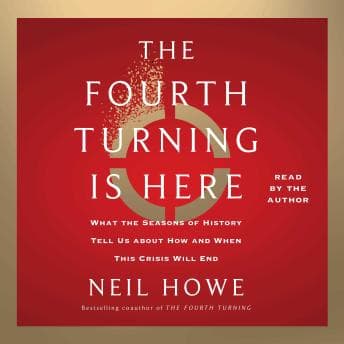

Twenty hours is a significant deployment of your time, and Neil Howe wants you to believe he can predict the future. The audacity of that claim had me skeptical from the jump. But here's the thing—by the time I finished this monster during a week of long drives between client sites, I wasn't rolling my eyes anymore. I was genuinely concerned.
Howe's thesis is deceptively simple: history moves in roughly 80-100 year cycles, each containing four "turnings" of about 20 years each. We're currently in the fourth turning—the crisis phase—and according to his math, things are going to get significantly worse before they get better around 2030. If you've been watching the news lately and thinking "this feels different," Howe's got receipts going back five centuries that suggest you're not crazy.
The Intel Is Solid, Even When It's Uncomfortable
I've sat through more than my share of briefings where analysts tried to predict enemy movements. Most were wrong. But occasionally you'd get someone who understood patterns well enough to be useful, and Howe reminds me of those guys. He doesn't claim to know exactly what will happen—he claims to understand the conditions under which certain types of events become likely.
What sold me was his breakdown of generational archetypes and how they interact during crisis periods. His analysis of how Boomers, Gen X, Millennials, and Zoomers will each respond to escalating conflict felt uncomfortably accurate. Brainstorm digs into similar generational psychology from a neuroscience angle, though with a much tighter focus on adolescence. The section on institutional decay hit particularly hard—I've watched organizations I served crumble from the inside, and his explanation of why that happens during fourth turnings tracked with what I witnessed.
The historical parallels he draws are extensive. Revolutionary War, Civil War, World War II—he walks you through each crisis period and shows how the pattern repeated. Some might call this cherry-picking. I'd call it pattern recognition, which is something military planners do constantly. Whether you buy his framework or not, the historical education alone is worth something.
Author Narration: A Double-Edged Sword
Howe narrates his own work, and honestly, it's the right call. His voice has that gravelly academic authority that makes you feel like you're getting a private lecture from someone who's spent decades thinking about this stuff. There's an audible investment in the material—he believes what he's saying, and that conviction comes through.
But—and this is where it gets rough—the man is reading a dense academic text for twenty hours. When he hits sections describing charts and data visualizations, the energy drops considerably. I found myself spacing out during these segments, which is a problem when you're trying to follow complex arguments about demographic shifts. At 1.25x speed, it's manageable, but this is absolutely not a background listen. Miss a key concept in hour three and you'll be confused by hour fifteen.
(Ranger, for what it's worth, lost interest around the generational cohort definitions and started snoring. Can't blame him.)
Where It Lost Me—And Found Me Again
Around the halfway point, I almost bailed. The density was exhausting, and I started wondering if Howe was just an elaborate doomsayer with better marketing than most. But then he pivoted to discussing what comes after the crisis—the potential for a new "high" period, a potential golden age. His analysis of what that might look like, based on post-crisis recoveries throughout history, pulled me back in.
He's not predicting apocalypse. He's predicting transformation through crisis—which, if you've ever been through combat, you understand. The worst moments often precede the most significant growth. That doesn't make them fun. It makes them survivable, with the right preparation.
Who Should Deploy—And Who Should Stand Down
If you want confirmation that everything is fine, look elsewhere. If you want a framework for understanding why things feel so chaotic right now—and a historically-grounded argument for how it might resolve—this is your mission. History buffs will appreciate the deep dives. Policy wonks will find the generational analysis useful. Anyone running a business or organization should probably understand his thesis about institutional collapse and renewal.
Skip it if you need action-packed content or can't commit focused attention. This isn't entertainment. It's education, and demanding education at that.
Mission Debrief
Worth your time? Yes, with caveats. The length is brutal, the density is real, and some sections drag. But Howe's core argument is compelling enough that I've found myself referencing it in client conversations about long-term planning. When a historian can make a security consultant rethink his ten-year outlook, that's saying something.
The 2030 timeline he proposes for crisis resolution lines up uncomfortably well with other threat assessments I've seen. Whether that's coincidence or pattern recognition, I'm not qualified to say. But I'm paying attention now.
Ranger approved this one—eventually. After his nap.