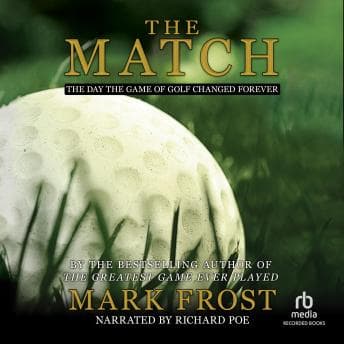

I'll admit it: I've never played a round of golf in my life. Denise dragged me to a driving range once for our anniversary—don't ask—and I spent more time chasing shanked balls into the parking lot than actually hitting anything. So when I started this audiobook about a 1956 private match between four golfers, I figured I'd last maybe an hour before switching to something with, I don't know, actual conflict.
Eight hours and forty minutes later, I was pacing my kitchen at midnight, completely ignoring the stack of sophomore essays on "The Great Gatsby" that were absolutely not grading themselves.
The Bet That Launched a Thousand What-Ifs
Here's what Mark Frost understands that most sports writers don't: the game is never really about the game. This is a book about ego, class, the strange alchemy of friendship and competition, and what happens when two millionaires decide to settle an argument the way millionaires do—by throwing legends at each other.
Eddie Lowery, the kid caddie who became a car dealer, essentially says "my amateurs can beat anyone." George Coleman calls his bluff and shows up with Ben Hogan and Byron Nelson. Fourteen major championships between them. This is like betting your nephew's garage band can outplay The Beatles, and then someone actually books The Beatles.
Frost spends the first half building these four men into people you genuinely care about. Hogan's near-fatal car accident and impossible comeback. Nelson's quiet retirement to his ranch. Ward's complicated relationship with his own talent. Venturi's hunger to prove himself. By the time they're standing on the first tee at Cypress Point, you understand the weight each man is carrying.
Richard Poe Gets the Assignment
This is where I expected the audiobook to fall apart. Sports narration can go wrong so easily—too breathless, too monotone, too much like a guy reading box scores. Richard Poe threads an impossible needle here. His voice has this warm, unhurried authority that reminds me of the best documentary narrators. He's not trying to make you excited. He trusts the material to do that.
The subtle tone shifts between characters work because he doesn't overplay them. Hogan's clipped intensity versus Nelson's gentler cadence—it's there if you're listening for it, but it never becomes a performance that distracts from the story. (My students would say he's "giving audiobook." I have no idea what that means, but I think it's a compliment.)
What really impressed me: Poe handles the technical golf descriptions without making them feel like instruction manuals. When he's describing the approach to the eighteenth hole, the ocean wind, the impossible pin placement, you can visualize it even if—like me—you couldn't tell a wedge from a spatula.
Why This Works Even If You Don't Care About Birdies
Frost is the co-creator of Twin Peaks, which should tell you something about his sense of atmosphere and tension. He treats this golf match like a thriller. The pacing builds methodically—each hole becomes a chapter in a larger drama, and by the back nine, I was genuinely anxious.
But here's what elevates it beyond sports writing: this is really a book about a vanishing world. The 1950s amateur ideal, the gentleman's game, the notion that the best players might not be professionals at all. Frost captures that moment right before television money and corporate sponsorship changed everything. There's an elegiac quality to it that reminded me of what Hemingway was doing with bullfighting in "The Sun Also Rises"—documenting a ritual before it disappears.
The match comes down to the eighteenth hole. I won't spoil how, but Frost's description of those final shots—the pressure, the physics, the psychology—is genuinely edge-of-your-seat stuff. And I was sitting at my kitchen table eating cold pizza at the time.
Who Should Clear Their Schedule (And Who Shouldn't)
If you love narrative nonfiction in the vein of Erik Larson or David Grann, this is your book. If you're a golf fan, obviously. But honestly? If you appreciate great storytelling about competition and character, the golf is almost incidental. That same focus on character over spectacle is what makes American Religious History work so well—it's nominally about theology, but really it's about people navigating impossible choices. The sport is the vehicle, not the destination.
Skip it if you need constant action. The first half is biography and context-building. It's essential, but if you're looking for something to power through a workout, this ain't it. This is focused listening—a long walk, a quiet evening, pretending to pay attention at faculty meetings. (Principal Martinez, I was definitely listening to your facilities update. I wasn't. I was on the fourteenth hole.)
Worth Every Ignored Essay
I started this book as a skeptic and finished it as an evangelist. Mark Frost took a single day in 1956 and turned it into something that feels genuinely important—a meditation on excellence, on what we owe to the games we play, on the strange way competition can reveal character. Richard Poe delivers it all with the steady authority of someone who knows exactly what he's doing.
My students would hate this. Too slow, too old, too much about rich guys hitting balls. But that's fine. Some books aren't for everyone. This one's for people who understand that the best prose deserves to be savored, that pause is punctuation, and that sometimes the best stories are the ones nobody was supposed to see.