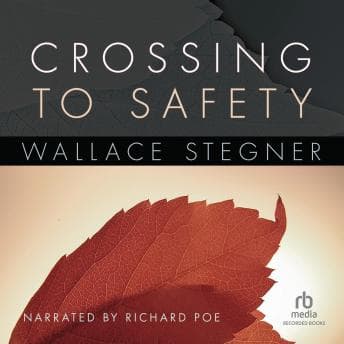

Wallace Stegner's Crossing to Safety is the quietest important novel I've ever listened to.
I don't mean that as a backhanded compliment. I mean it the way you'd describe a conversation with someone you've known for thirty years — where the silences carry as much weight as the words, and nobody's trying to impress anybody anymore. Stegner wrote this as his final novel, published in 1987 when he was 78, and you can feel a man looking backward through decades of friendship and marriage and professional jealousy with the kind of clarity that only comes when you've stopped pretending.
I started this one on a Saturday walk along the lakefront with Denise. By hour two, she asked why I was so quiet. I told her I was listening to two couples argue about ambition and money and who gets to be the talented one in a marriage. She said, "So, a documentary about us?" She's not wrong.
Two Marriages, One Mirror
The setup sounds almost too simple: Larry and Sally Morgan, young and broke and hopeful, arrive at the University of Wisconsin during the Depression and fall into friendship with Sid and Charity Lang, who have family money and connections and all the social confidence that comes with never worrying about rent. The friendship lasts decades. That's it. That's the plot.
But Stegner isn't interested in plot the way most novelists are. He's interested in what happens to people over time — how Charity's relentless drive to make Sid a published poet slowly becomes a kind of suffocation, how Larry's quiet ambition and Sally's polio reshape their marriage into something unexpectedly sturdy, how money sits between friends like an uninvited guest at every dinner. There's a scene — or rather, a long, uncomfortable sequence — where Charity essentially engineers Sid's career with the force of her personality, and you realize you're watching someone love another person so aggressively it becomes its own form of cruelty. Stegner doesn't flag it. He just lets you sit in the room and feel the temperature drop.
This reminds me of what Hemingway said about writing — leave out the thing and the reader will feel it more. Stegner does that, but with decades instead of moments. The compression of forty years of friendship into twelve hours of audio means you're constantly recalibrating: wait, are we in Vermont now? Is Sally in the wheelchair yet? How did twenty years just pass in a paragraph? It rewards attention. It demands it, actually.
Richard Poe Knows That Pause Is Punctuation
Richard Poe narrates this at exactly the right register — warm, unhurried, with the cadence of a man telling you something important over coffee. He doesn't do voices, not really. What he does is shift his tone so subtly between characters that you always know who's speaking without ever feeling like you're watching someone perform. Charity sounds sharper, more clipped. Larry's narration carries a kind of resigned wonder. It's the difference between a narrator who reads and a narrator who interprets, and Poe is firmly in the second camp.
The prose deserves to be savored. Stegner writes sentences that unfold like someone carefully opening a letter, and Poe gives them room to breathe. I listened at 1.0x — the author chose those words — and I'm glad I did. There are passages about the Vermont summers, about light on a lake, about the particular quality of laughter between old friends, that would lose half their power at 1.25.
If I have a quibble, it's that the middle hours — roughly four through eight — require patience. Stegner is building something cumulative, layering observation on observation, and there are stretches where you might wonder if anything is actually happening. Something is. You just won't realize it until later, when a single quiet line about Charity's face at a dinner table hits you like a freight train because of everything that came before.
The Stegner Nobody Assigned You
Most people who know Stegner know Angle of Repose — the Pulitzer winner, the big historical canvas. Crossing to Safety is smaller, more intimate, and honestly? I think it's better. Angle of Repose impresses you. This one changes the way you look at the people sitting across from you at dinner. Someone compared Stegner's style here to Richard Russo, and I see it — that same attention to the way class and money quietly corrode even the best relationships. But Stegner is less comic, more elegiac. He's not trying to make you laugh. He's trying to make you pay attention.
My students would hate this. I love it. There's no murder, no romance in the bodice-ripping sense, no twist. There's just the accumulated weight of four lives lived together and apart, and the slow realization that the people you love most are also the people you can never fully understand. If you loved Remains of the Day or Marilynne Robinson's Gilead, this is their spiritual successor — or maybe their ancestor.
Who This Is For (And Who Should Walk Away)
If you need things to happen — car chases, betrayals, dramatic reveals — skip this. You'll be miserable by hour three. The same warning applies to Ember in the Ashes — that one moves fast and wants you to keep up, which is almost the opposite experience of what Stegner is doing here. If you're the kind of listener who finds a long walk with good prose to be its own reward, this is twelve hours you won't regret. It's a focused-listening book. Don't try it while grading papers at 11 PM. (I made that mistake once and had to rewind forty minutes because I'd been reading the same student essay about The Great Gatsby and lost the thread entirely.)
Worth pausing the faculty meeting for. Worth pausing everything for, really.
The Lesson Plan I'll Never Assign
I'll never teach this book. It requires the kind of life experience my juniors don't have yet — the experience of watching a friendship change over decades, of noticing the moment when someone you love starts becoming someone you pity. But I'll keep recommending it to every adult I know, because this is why we still read the classics. Not for the plot. For the recognition. That sharp, uncomfortable moment when a sentence written by a man born in 1909 describes your own marriage, your own friendships, your own quiet failures with an accuracy that makes you set down your coffee and stare at the wall for a minute.
Stegner's last novel. And maybe his truest.