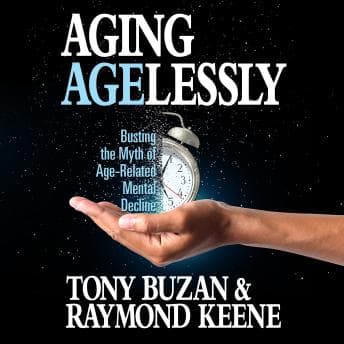

What if everything your parents told you about getting forgetful with age was just... wrong?
I was on my morning jog through Cambridge - one of those gray November mornings where your breath fogs and you question every life choice - when Tony Buzan started dismantling my assumptions about cognitive decline. And I found myself slowing to a walk, not from exhaustion, but because I needed to actually process what I was hearing.
The Mind Mapping Guy Has Thoughts About Your Aging Brain
So here's the thing about Tony Buzan: he's the person who popularized mind mapping, that technique your overly organized colleague swears by. The research actually shows he was onto something - he studied the note-taking methods of da Vinci and Einstein and turned them into a system. This isn't some random wellness guru; this is someone who spent decades studying how brains actually learn. That same commitment to understanding how learning actually works shows up in Call of the Wild and Free, though applied to children rather than aging adults.
The central thesis is almost aggressively optimistic: your brain doesn't deteriorate with age. It can improve. Buzan argues that older brains have more neural connections, more adaptations, more flexible pathways because they've simply experienced more. The protagonist in this case study is your own mind, and what makes it compelling is the reframing - we're not fighting decline, we're building on accumulated advantage.
Psychologically, this tracks with what we know about neuroplasticity. The brain isn't a hard drive that fills up and slows down. It's more like a muscle that responds to use. But here's where my academic skepticism kicks in: Buzan makes big claims, and while the underlying science is sound, some of the promised outcomes ("achieve just about anything you want") veer into self-help hyperbole territory.
Memory Techniques That Actually Have Research Behind Them
The practical sections are where this audiobook earns its keep. Buzan walks through specific memory techniques - the kind I've seen referenced in cognitive psychology literature for decades. Name recall strategies. The method of loci (though he doesn't call it that). Association chains for retaining facts.
What I appreciated: he doesn't just tell you these techniques exist. He explains the mechanism. Why does creating a vivid mental image help you remember a name? Because your brain evolved to remember locations and faces, not abstract data. You're essentially hacking your own evolutionary wiring.
What frustrated me: at 6 hours and 38 minutes, this could have been tighter. Some concepts get repeated with slight variations, which - okay, maybe that's intentional reinforcement? My therapist would have thoughts about whether Buzan is practicing what he preaches or just padding runtime.
Sean Pratt Reads Self-Help Like It's an Instruction Manual (And That Works)
Sean Pratt has that clear, authoritative voice that works for instructional content. He's not trying to be your friend or inspire you with dramatic pauses. He's delivering information. For this type of book, that's exactly right. You don't need emotional performance when someone's explaining how to remember a phone number.
The pacing is measured - almost classroom-lecture measured. I found myself bumping to 1.25x during my second listen (yes, I listened twice, once jogging, once cooking dal that got slightly overcooked because I was taking mental notes). At regular speed, it drags in places. Pratt's consistent tone becomes almost hypnotic, which is either meditative or soporific depending on your caffeine levels.
Who Needs This Reframe (And Who'll Find It Frustrating)
If you're someone who's noticed you can't remember where you put your keys and you've internalized the narrative that this is inevitable decline - Buzan wants to shake you out of that. The reframe alone might be worth the listen.
But if you're looking for cutting-edge neuroscience or rigorous citations, you'll be disappointed. This is popular psychology, not academic psychology. The techniques are legitimate, but the packaging is very much "you can achieve anything!" self-help energy.
I found myself asking: why does this book feel simultaneously convincing and slightly oversold? Because Buzan genuinely knows his stuff about memory and learning, but he's also selling hope. And hope is a powerful motivator, even when it comes with a side of marketing speak.
Skip this if you want hard science. Listen if you want practical techniques wrapped in encouraging framing. And definitely listen if you've bought into the myth that your best cognitive years are behind you.
Clinical Notes
Buzan exhibits classic confirmation bias in his own favor - every anecdote supports his thesis. But the underlying framework is sound enough that I'm willing to forgive the cheerleading. Your brain is more plastic than you've been told. The techniques here can help. Just don't expect miracles, and maybe keep that playback speed at 1.25x.