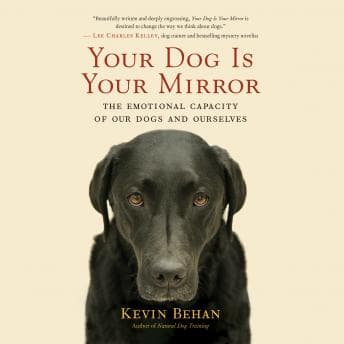

So everyone on the dog-training internet seems to have a strong opinion about this book. Half the reviews treat Kevin Behan like some kind of canine whisperer prophet, and the other half think he's peddling pseudoscience wrapped in feel-good anecdotes. After 12 hours with Patrick Lawlor reading this to me, I'm... somewhere in between, leaning skeptical, and honestly a little frustrated.
I picked this up because Kevin (my boyfriend, not the author - though the name overlap created some very confusing text messages) adopted a rescue last month, and the dog has been doing this thing where she mirrors his anxiety in the most uncanny ways. He paces, she paces. He's calm on the couch, she's a puddle at his feet. So when I saw the title, I thought: okay, here's the science behind that. Give me the distributed systems architecture of dog-human emotional connection.
That is not what this book is.
When Your Dog Training Book Becomes a Physics Metaphor
Behan's central thesis is interesting - dogs respond to our emotions, not our commands, and their behavior is essentially a mirror of our internal state. Cool. I'm on board for maybe the first three hours. He talks about growing up under his father John Behan's dominance-based training methods, how he watched dogs break under that paradigm, and how he slowly developed this alternative framework where the dog's drive to hunt cooperatively is what really makes training possible. The autobiographical stuff is genuinely good. You can feel the friction between father and son, between old-school alpha-roll methodology and something softer. That same push-pull between inherited frameworks and hard-won personal insight is something Marshmallow Test handles well too - Mischel spends real time reckoning with how his own assumptions shaped decades of research before the field finally caught up with him.
But then he starts pulling in concepts from physics - energy, magnetism, "emotional conductivity" - and using them as literal explanatory mechanisms rather than metaphors. And look, I debug distributed systems for a living. I know the difference between a useful analogy and cargo-cult science. When Behan describes a dog's prey drive as functioning like an electromagnetic field, he's not drawing a comparison. He seems to genuinely believe this is how it works. There's no peer-reviewed backing, no controlled studies. Just decades of his own training experience filtered through this idiosyncratic theoretical lens.
It's like if someone wrote a book about TCP/IP but explained packet loss through astrology. The observations about network behavior might be accurate! But the explanatory framework is... doing a lot of unsupported heavy lifting.
Patrick Lawlor Does What He Can
Lawlor's narration is clean and professional. Consistent pacing, clear diction, no weird audio artifacts. But here's the thing - this book is 12 hours of one man's increasingly abstract theorizing about canine emotion, and Lawlor reads it with the same steady, even tone throughout. There's no vocal differentiation when Behan shifts between anecdote mode and theory mode, which means around hour 6 you genuinely can't tell if you're hearing a story about a specific golden retriever or a metaphysical claim about emotional energy transfer between species.
At 6:15 AM on the Caltrain, surrounded by fellow zombies, I lost the thread multiple times. Had to rewind. This is NOT a commute book. I ended up finishing it during a Sunday afternoon where I could actually sit down and pay attention, and even then I caught myself zoning out during the longer theoretical passages.
For comparison, I recently listened to "The Genius of Dogs" by Brian Hare (also narrated pretty straightforwardly) and that book does the science-of-canine-cognition thing with actual research citations and still manages to be engaging. Behan's book has better stories but worse intellectual rigor, which is an annoying combination because the stories make you want to believe the theory.
Who This Is Actually For (And Who Should Run)
If you're a dog person who already vibes with energy-based or emotion-first training approaches - Behan's your guy. He writes with genuine passion and decades of hands-on experience. The anecdotes about specific dogs he's trained are the highlight, especially a long section about working with aggressive dogs where his method of "absorbing" the dog's energy (his words) actually produces visible behavioral changes. Whether you buy his explanation or not, the man clearly knows how to work with dogs.
But if you're coming from a science background wanting evidence-based animal behavior insights? You're going to spend a lot of this book arguing with your earbuds. I literally muttered "citation needed" out loud on the train and got a look from the woman next to me.
The ROI on this audiobook is low for the 12-hour investment. There's maybe 4 hours of genuinely useful content about reading your dog's emotional state and understanding how your own stress affects their behavior. The rest is Behan's theoretical framework, which - whether it's brilliant or bonkers - needed a much more rigorous editor.
Could've been a blog post. Okay, maybe a blog series. But not 12 hours.
Commute-Worthiness: Leave This One at the Station
I wanted to love this more than I did. The core insight - that your emotional state profoundly shapes your dog's behavior - rings true to anyone who's lived with a dog. But Behan buries that insight under layers of unsubstantiated theory, and Lawlor's steady-state narration doesn't help you stay locked in when the material gets abstract. Speed it up to 1.5x minimum, and even then, keep your finger on the rewind button.







![Steve Jobs [unabridged audiobook] audiobook cover](/_next/image?url=https%3A%2F%2Fcovers.audiobooks.com%2Fimages%2Fcovers%2Ffull%2F9788499923406.jpg&w=1920&q=75)