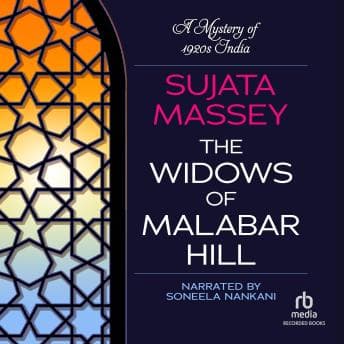

Everyone kept telling me this was a 'cozy historical mystery' and I went in expecting something gentle and pleasant, maybe a little slow. They were wrong. Or at least, they undersold it.
I started this one on a Saturday afternoon while batch-cooking adobo for the week - Carlos takes the kids to soccer on Saturdays, so the kitchen is mine and the Bluetooth speaker is mine and I can just... exist for a while. And I'm stirring the pot, expecting something light, and within the first hour Sujata Massey has me standing completely still in my kitchen because Perveen Mistry's backstory is hitting way harder than I anticipated.
A Lawyer Who Fights Like a Nurse
Here's what got me about Perveen: she's not solving crimes because she's brilliant and bored. She's doing it because the system is designed to ignore the women she's trying to help. The Farid widows live in purdah - complete seclusion from men - which means they can't speak to male lawyers, can't go to court, can barely advocate for themselves at all. And when Perveen notices that one widow signed her inheritance away with an X because she can't read? That quiet rage she feels? I know that feeling. Different context, obviously, but I've watched patients get railroaded by systems that aren't built for them. I've been the person in the room who says "wait, something's not right here" while everyone else is ready to move on.
The legal details felt solid. The way Massey lays out Muslim inheritance law, Zoroastrian family dynamics, British colonial legal structures - it's a lot, but it never reads like a textbook. It reads like context that matters. Perveen needs to understand these overlapping systems to protect her clients, and Massey trusts you to follow along.
Soneela Nankani Made Me Forget I Was Cooking
I literally burned my garlic. That's my narrator review.
But seriously - Nankani does something I really appreciate, which is she doesn't do cartoonish accent work. Her base narration is warm American English, and then she layers in subtle Indian accents for dialogue that shift depending on the character's background and social class. It's restrained. It's smart. You can tell the difference between Perveen's educated Parsi family and the household servants and the British officials without anyone being turned into a caricature.
Her emotional range is what sold me though. There's a whole extended flashback section - Perveen's marriage and what happened to her in Calcutta - and Nankani captures this specific kind of young woman's anguish where you're realizing the life you chose is a trap but you're too proud and too scared to admit it yet. Carlos asked why I was crying in the car. I blamed allergies. (I was actually relistening to that section on my Monday drive home. It hit different at 7 AM after twelve hours in the trauma bay.)
The Mystery That's Actually About Power
If you're coming to this for a fast-paced whodunit, recalibrate. At 14 and a half hours, this is a slow burn. The murder doesn't happen until well into the book, and Massey spends a good chunk of time on Perveen's past and on the social architecture of 1920s Bombay. Some mystery readers will find that frustrating. I found it necessary.
Because when the violence does come, it lands harder for all that context. You understand exactly what's at stake - not just who killed whom, but what happens to these widows and their children if Perveen can't navigate a system that wasn't built to include her either. She's one of the first female lawyers in India. Every room she walks into, someone's surprised she's there.
The actual mystery plot is solid if not groundbreaking. I figured out part of the who before Perveen did, but that didn't bother me because the book isn't really a puzzle box. It's about a woman using her specific, hard-won expertise to protect people who've been made invisible.
My mom would love this. She still thinks I should've been a doctor, but she'd appreciate Perveen's particular brand of stubborn professional excellence in the face of everyone telling her she doesn't belong. That's a Filipino value if I've ever seen one.
Who This Is For (And Who Should Keep Scrolling)
Perfect for: Anyone who loves historical mysteries where the setting is as important as the crime. Fans of Jacqueline Winspear's Maisie Dobbs but want something outside the British-centric lane. Readers who care about women's legal history and don't mind a slow build to a payoff. And honestly? Anyone tired of mystery heroines who are quirky for quirky's sake. Perveen's motivations are grounded in real pain and real principle. I had a similar reaction to Language of Flowers — another book where the protagonist's expertise and damage are completely inseparable, and where I kept thinking, this person is fighting for something, not just solving something.
Skip if: You need a body by chapter three or you're out. Or if you're looking for something to half-listen to while doing other things - this requires your attention. The legal and cultural details are the point, not decoration.
Night Shift Stamp of Approval
I'm already queuing up the second book. This one earned the increasingly rare honor of making me sit in my car in the driveway for an extra ten minutes because I wasn't ready to go inside and be a functional adult yet. Soneela Nankani's AudioFile Golden Voice status? Earned. Every minute of those fourteen hours.