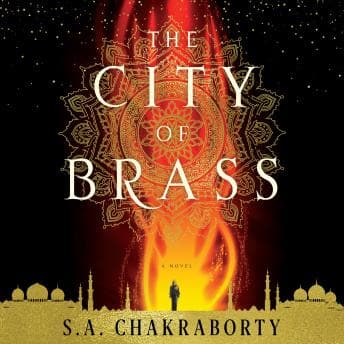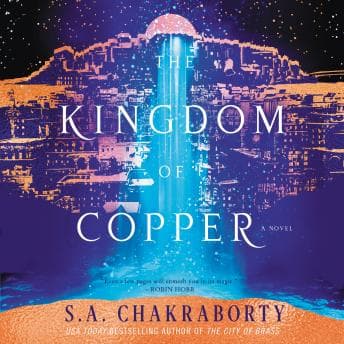

Look, I need to rant for a second. Twenty-three hours. This book is twenty-three hours long and Chakraborty has the audacity to end it the way she does, knowing full well I have a thesis committee meeting in two days. I was up until 3 AM on a Tuesday — not coding, not working on my procedural generation research, not even playing Baldur's Gate — just sitting in my dark apartment with my headphones on, whispering "no no no no" at Dara's choices like he could hear me. Dr. Patel, if you're reading this: I regret nothing.
Daevabad Is the Dungeon Map I'd Spend Six Sessions Drawing
This is Sanderson-level world-building. I don't say that lightly. Chakraborty constructs Daevabad like she's been running a campaign in it for decades. The tribal politics between the Daevas, the shafit, the Geziris — this isn't just window dressing, it's load-bearing narrative architecture. Every faction has legitimate grievances, which means every alliance feels precarious and every betrayal feels earned. My D&D group would love this — we spent three real-world months on a city-state political arc and it had maybe a quarter of the complexity here.
What kills me about Kingdom of Copper specifically (as opposed to City of Brass) is how the scope expands without losing the personal stakes. Ali's exile into the copper desert is genuinely harrowing — this isn't a quick "wandering in the wilderness" montage. His marid water abilities are creeping and unsettling in a way that reminds me of a warlock who didn't read the fine print on their patron's contract. And Nahri's arc in Daevabad? She's running a hospital while navigating a court that would happily see her dead. The food descriptions alone — the saffron rice, the street vendors, the feast preparations for the new century celebrations — made me pause the audiobook to order takeout at midnight. Twice.
The archery contest near the end? Chef's kiss. It's one of those scenes where politics, personal grudges, and spectacle collide and you realize you've been holding your breath for five minutes. Chakraborty builds to it so carefully that by the time it happens, every arrow carries the weight of three different plot threads.
Soneela Nankani Walked So — Actually, She's Still Running
Steven Pacey walked so other narrators could run, but Soneela Nankani is sprinting in her own lane. Sixteen Earphones Awards and a Golden Voice honor — yeah, that tracks. Her performance here is the kind where you forget there's a narrator. She disappears into the text in a way that's almost eerie. Her Ali voice carries this earnest, slightly too-idealistic energy that makes you want to shake him and protect him at the same time. Her Nahri has steel underneath the charm. And her Dara — there's this barely-contained grief in how she voices him that made certain scenes genuinely hard to listen to. Not because of quality. Because of pain.
The pacing matches the book perfectly. Kingdom of Copper is a slow burn for the first chunk — we're talking political positioning, relationship rebuilding, quiet dread. Nankani doesn't try to force urgency where there isn't any. She trusts the text. And then when things start accelerating in the back half, her delivery shifts to match and suddenly you're in the 3 AM situation I described above.
One small thing: the start does take a bit to find its rhythm. The first couple hours felt slightly methodical compared to where it ends up. But honestly? That might be the book's structure more than the narration. Middle volumes in trilogies have to do a lot of table-setting. If you don't like info-dumps, this isn't for you (but you're wrong).
Who Should Burn a Credit on This
If you liked City of Brass, this is better. The progression is satisfying — Chakraborty levels up her craft the way a good campaign levels up its party. If you're into politically complex fantasy with a non-European setting, this is essential listening. If you want your fantasy diverse in mythology without feeling like a lecture about it — Chakraborty draws from Islamic history and djinn lore with the confidence of someone who's done the research and the love.
Skip this if: you need constant action (the first half is palace intrigue and character work), you haven't read book one (do not start here, you will be lost), or you can't handle a cliffhanger that will make you immediately buy book three. The same warning applies to Exit Strategy — another book I finished at an ungodly hour because the ending made stopping feel physically impossible. Which I did. At 3:07 AM. On a school night.
Yes, it's 23 hours. Yes, it's worth it.
I Read This Instead of Writing My Thesis and I'd Do It Again
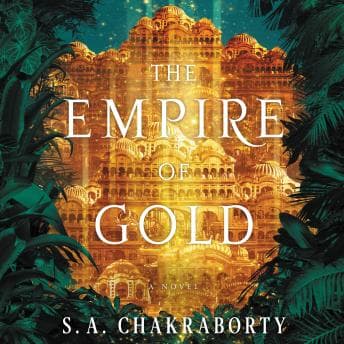
This is a middle book that doesn't feel like a middle book. It deepens everything City of Brass established, raises stakes without cheap tricks, and ends with enough momentum to make the final installment feel urgent. Nankani's narration is the real deal — patient, passionate, and completely in service of the story. I've already started Empire of Gold. My thesis timeline weeps. I do not care.