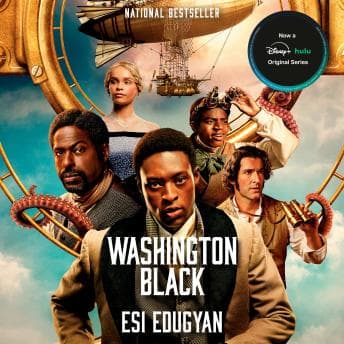

So here's the thing - I picked this up because I'd burned through my entire Cosmere reread queue and needed something completely different while debugging a procedural terrain generator at 2 AM. Literary fiction about a slave boy and an abolitionist inventor with a flying machine? Sure, that's basically steampunk D&D backstory. I was not prepared for what Esi Edugyan actually delivered.
Everyone talks about this book like it's a prestige literary novel you're supposed to admire from a respectful distance. Man Booker finalist, Giller Prize winner, all that. And yeah, it is that. But nobody told me it reads like an adventure campaign with the most brutal DM alive. Wash goes from a Barbados sugar plantation to riding a cloud-cutter (basically a hot air balloon contraption) across the Caribbean, then to the frozen Arctic, then London, then Morocco. The geographic scope here is genuinely wild. If someone pitched this at my D&D table I'd say "slow down, we haven't even left the first continent yet."
A Character Sheet That Actually Evolves
Wash starts as an eleven-year-old field slave - no agency, no voice, just survival. Christopher Wilde, his master's brother, is this weird abolitionist-inventor-naturalist who treats Wash like a person but also, uncomfortably, like a project. And Edugyan doesn't let you forget that tension. Wilde is genuinely kind and genuinely self-serving in ways that feel painfully real. He's not a villain, he's not a savior, he's just... a complicated white man in the 1830s who thinks his good intentions are enough.
The progression is satisfying - Wash grows from frightened child to skilled scientific illustrator to a man trying to figure out who he is when every identity he's been given was assigned by someone else. But here's where the book loses some HP: the second half doesn't hit as hard as the first. Once Wash separates from Wilde, the story kind of drifts. The ending fizzles in a way that feels like Edugyan had this incredible setup and then wasn't quite sure how to land the dismount. Some secondary characters - Tanna especially, who becomes Wash's love interest - feel like they needed another draft to become fully real people instead of plot furniture.
Dion Graham: The Narrator Discourse
Okay, so Dion Graham is polarizing and I get why. He reads this like it's being told by adult Wash looking back on his life, which is the right call. The subtle voice shifts work - he's not doing cartoon voices for every character, he's doing perspective. You hear Wilde's enthusiasm filtered through how Wash experienced it. That's smart narration.
But. There are moments where Graham cranks the emotional dial to like, 11. Some tense scenes hit this breathless, almost melodramatic register that pulled me out of the story. I've seen people describe it as "telenovela mode" and honestly? I laughed because yeah, there are flashes of that. It's not constant, and when he nails it - the quiet scenes, the moments of Wash processing trauma he doesn't fully understand yet - it's genuinely excellent. But the inconsistency means you're occasionally jarred by a shift from understated grief to full theatrical crescendo.
Steven Pacey he is not. (Steven Pacey walked so other narrators could run, but that's an unfair standard for literally everyone.) Graham is good. He won an Earphones Award for this. I actually went back and listened to his work on Dead are Arising: The Life of Malcolm X after this, and he brings a similar gravity to that narration—less of the melodramatic spikes, more of the controlled intensity I wanted more of here. Some people think he's one of the best they've ever heard. I'd put him at strong but uneven - which for a 12-hour solo performance is honestly pretty solid.
Who Should Roll Initiative On This
If you want pure fantasy, this isn't that. But if you've ever loved a D&D character's backstory more than the actual campaign - the tragic origin, the unlikely mentor, the journey across impossible landscapes - this scratches that itch in a literary fiction wrapper. Fans of world-spanning adventure with actual emotional weight will dig it. If you don't like info-dumps, this isn't for you (but you're wrong) - Edugyan loves her period detail and I'm here for the 1830s scientific expedition vibes.
Skip it if you need a tight ending. The last quarter genuinely loses momentum and the romantic subplot needed more room to breathe. Also skip if you're narrator-sensitive - Graham's style is love-or-hate and you won't know which camp you're in until you're a few hours deep.
I read this instead of writing my thesis. Dr. Patel would probably approve of this one, actually - it's the kind of book you can mention in polite academic company without getting a raised eyebrow. Unlike my usual 40-hour LitRPG consumption. Progress.
Worth the Spell Slot?
Solid book. Imperfect ending. Strong-but-uneven narrator. The first eight hours are legitimately great adventure fiction wearing a literary costume, and the world-building of 1830s scientific exploration culture is chef's kiss. It just doesn't stick the landing hard enough for me to tell you to burn a credit on it when you could wait for a sale or grab it from the library.