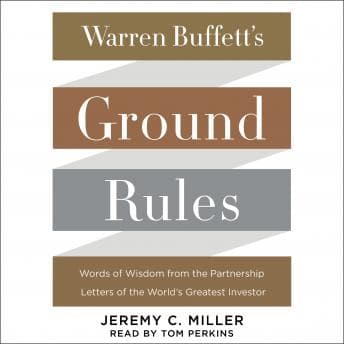

What if the most useful investing book ever written wasn't actually a book at all - but a stack of letters from a 25-year-old in Omaha to a handful of people who trusted him with their money?
I was up past midnight crunching a financial model for a client's Series B pitch when I threw this on. Figured it'd be background noise, another Buffett hagiography I could half-listen to while tweaking revenue assumptions. Three hours later, the spreadsheet was untouched and I was scribbling notes in the margins of a napkin. That hasn't happened since I read The Outsiders for the first time. The same thing happened with Thinking, Fast and Slow — Kahneman kept pulling me away from whatever I was supposed to be doing because the framework he was building felt too useful to set aside.
The Partnership Letters Nobody Talks About
Here's what got me. Everyone knows Berkshire Hathaway Buffett. The folksy Oracle of Omaha who drinks Cherry Coke and makes dad jokes at shareholder meetings. But this book covers 1956 to 1970 - the years before all that, when Buffett was running a small partnership out of his house, writing brutally honest letters to his partners about what he was doing and why. Jeremy Miller, a first-time author and equity analyst, compiled these letters with Buffett's permission and structured them around key principles.
The gold here is watching Buffett's framework get built in real time. His contrarian diversification strategy - where he'd put massive portions of the partnership into a single position if he had enough conviction - runs completely counter to every piece of advice your financial advisor gives you. He breaks his investments into three categories: "Generals," "Workouts," and "Controls." Each with different risk profiles, different expected returns, different time horizons. This isn't abstract theory. He walks through specific allocation decisions and explains his reasoning in those original letters.
What hit me hardest was his approach to compounding. Not as a concept - everyone talks about compounding - but as an almost religious discipline. He was obsessing over the math of compounding at an age when most people are still figuring out their 401(k). This is what my parents did instinctively. Now it has a TED talk. They plowed every dollar from the dry cleaning business back into the business, year after year. No flash, no lifestyle inflation. Buffett was doing the same thing, just with other people's money and a lot more zeros.
Where the 10 Hours Actually Land
Let me be straight about the format. This is dense. Miller structures the book thematically - chapters on conservatism vs. convention, on beating the Dow, on the psychology of market downturns - and weaves in excerpts from the partnership letters with his own analysis and modern context. It works better than I expected. But at 10 hours, there's stretching. Some of Miller's contextualizing feels like padding around the genuinely electric Buffett quotes. You'll hit stretches in the middle where Miller is explaining concepts that any listener who picked up this book probably already understands.
The key takeaway is worth the listen. The other 7 hours? Not so much. But those 3 hours of concentrated Buffett thinking - his framework for measuring performance against the Dow rather than in absolute terms, his insistence on a 10% annual edge as a reasonable target, his explanation of why he preferred "conservative" to "conventional" decision-making - that stuff is genuinely useful. I've seen the conventional approach fail at three different companies I've consulted for. Buffett was calling it out sixty years ago.
Tom Perkins narrates, and he does something smart with this material: he doesn't try to dramatize it. The delivery is clean, engaged, and he finds a rhythm with the dense financial passages that keeps you tracking the logic rather than zoning out. For a book that's essentially an annotated collection of investment letters, that's no small feat. He earned that AudioFile Earphones Award. Not flashy, just competent - which is exactly what this book needs.
Who Gets the ROI
If you're a serious investor - not a meme stock gambler, not a crypto bro, but someone who actually thinks about value and long-term compounding - this is essential listening. If you're a founder or operator trying to understand how patient capital thinks, there's real strategic insight here. If you want Buffett's actual thinking process rather than the sanitized greatest-hits version, this is the closest you'll get without buying Berkshire shares and showing up in Omaha.
Skip this if you want actionable stock picks or get-rich-quick frameworks. Buffett would tell you to skip it too.
Bottom Line: Worth the Midnight Oil
I finished the model at 2 AM. But I also came away with a cleaner framework for how I talk to my startup clients about capital allocation and patience. Jenny found me asleep on the couch with my AirPods still in. She asked if it was "another one of those books." Yeah. But this one earned its runtime. Mostly.