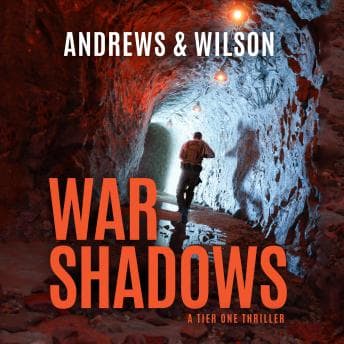
Andrews and Wilson get it right where most military thriller authors get it wrong.
I finished War Shadows on a late Sunday drive back from a client site in San Antonio - the kind of dead-straight I-35 run where your mind needs something with teeth or you'll end up drifting into a guardrail. This book had teeth. Not razor-sharp, perfectly honed teeth, but enough bite to keep me locked in for the full 11 hours. I've sat through a few same-genre disappointments recently - Whispers had the bones of something gripping but never quite committed to the operational realism that makes or breaks this stuff for me.
These Authors Actually Know Which End the Bullet Comes Out Of
Let me cut to the chase - Brian Andrews is a former submarine officer. Jeffrey Wilson has done trauma surgery. These aren't guys who Googled "how does a SEAL team breach a door" and called it research. The tactical details in War Shadows land with the kind of quiet accuracy that separates real from fake. Nobody's racking the slide on a Glock that's already chambered. Nobody's pulling a pin on a grenade and holding a conversation for thirty seconds before throwing it. The Ember task force operates with procedures that actually track - the way Dempsey's team communicates during ops, the decision cycles, the friction between intelligence and action. I've seen this scenario play out in real life, and the authors clearly did their homework.
The Iraq sequences hit a specific nerve. There's a gritty authenticity to the desert ops that goes beyond "it was hot and sandy." Andrews and Wilson capture the cognitive load of operating in a place where the threat matrix is three-dimensional and constantly shifting. And when the action moves to Guatemala and then stateside, the contrast works - the threat follows Dempsey home, which is the kind of thing that keeps guys like me checking our six at the grocery store even a decade after hanging up the uniform.
The Chunk Factor and Why Pacing Is a Two-Edged Sword
The introduction of Chunk might be the best thing about this second installment. The chemistry between him and Dempsey has genuine snap to it - the kind of ball-busting camaraderie that only works when the writer has actually been in a team room and heard how operators talk to each other. I caught myself laughing out loud at a couple of their exchanges, which earned me a look from Ranger in the rearview mirror.
But here's where it gets complicated. The book cuts between Dempsey's Ember team and the antagonist's perspective, and some of those transitions feel like hitting a speed bump at 60 mph. You're locked into a scorching action sequence - adrenaline up, heart rate elevated - and then you're suddenly in the bad guy's head for what feels like a mandatory chapter of villain motivation. I get the structural choice. You need to build the threat to make the payoff land. But the pacing stumbles during those handoffs. It's not fatal, but around hours five and six, I noticed my attention drifting.
The villain himself - an old nemesis resurfacing after ten years in the shadows - is solid enough. Not the most original setup (former threat returns with a new plan is pretty well-worn territory in this genre), but Andrews and Wilson give him enough operational sophistication that he doesn't feel like a cartoon. The attacks he's planning against the homeland have a plausibility that's uncomfortable in the right way.
Ray Porter Does Not Miss
Ray Porter narrating a military thriller is like having a seasoned NCO run your comms - everything comes through clean and with authority. The man punches every word home. His voice work for different characters is distinct enough that you never lose track of who's talking, which matters in a book with this many operators and intelligence personnel moving through scenes. His female voices are... fine. Not distracting, which is honestly the best you can hope for with a male narrator handling women's dialogue. His emotional delivery during the quieter moments - the scenes where Dempsey is grappling with the cost of his covert life - actually lands. Porter doesn't overplay it. He trusts the prose, and the prose has some genuinely poignant lines buried in all the gunfire.
At 1.25x, Porter's pacing was perfect. His natural cadence is measured enough that the speed bump helps without making him sound like a chipmunk.
Worth Your Time? Here's the Debrief
If you read the first Tier One and liked it, War Shadows is a worthy sequel. It's not a quantum leap forward - it's an incremental improvement. The tradecraft is sharper, the team dynamics are richer (thank Chunk for that), and the domestic threat angle adds stakes that pure overseas ops can't match. The pacing hiccups during POV transitions keep it from being elite, but they don't sink the mission. Crimson Shore ran into the same structural wall - strong central tension, but the villain POV chapters bled momentum at exactly the wrong moments.
Who should listen: Anyone who wants military thrillers written by people who've actually worn a uniform. If you're a Vince Flynn or Brad Thor reader looking for something with more authentic operational DNA, this is your lane. Who should skip: If you need breakneck pacing with zero letup, those villain interludes will test your patience.
Ranger approved this one. He perked up during the action sequences and slept through the villain chapters, which - honestly - tracks pretty well with my own experience.