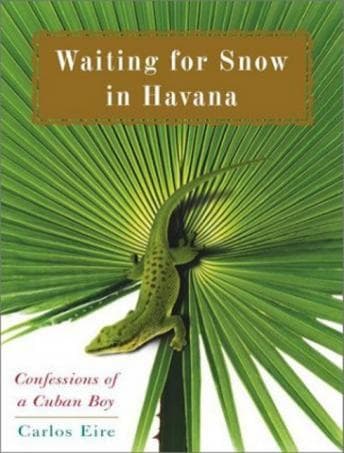

Everyone kept telling me this was 'Angela's Ashes but Cuban.' Which—okay, I get the comparison. Privileged kid loses everything, ends up in America, writes about it beautifully decades later. But that framing undersells what Carlos Eire actually accomplishes here. This isn't poverty porn in reverse. It's something stranger and more honest.
I started this one at 2am, couldn't sleep, mind racing about a client whose startup is hemorrhaging cash because the founder won't accept that the market has shifted. Sometimes you need perspective. A book about a kid watching his entire world dissolve in 1959 Havana? That's perspective.
When Your Father Thinks He Was Louis XVI
The details in this memoir are wild. Eire's father was convinced—genuinely, deeply convinced—he'd been the beheaded French king in a past life. The family home was stuffed with artifacts and paintings like a museum. Neighbors had monkeys that escaped across rooftops. Kids at school showed up with bodyguards because their dads worked for Batista. This is what my parents did instinctively—the work, the sacrifice—but in a completely different universe. Eire grew up in a Havana that sounds like magical realism except it was just... Tuesday.
And then Castro arrives. Christmas gets cancelled. The firing squads start. Classmates vanish one by one, spirited away to the States through what would become Operation Pedro Pan. Eire himself eventually goes—a child, alone, never seeing his father again.
The key takeaway is worth the listen. The other 7 hours? Actually, they're worth it too. This is a 16-hour commitment, but Eire earns every minute because he's not just recounting events. He's doing something harder—trying to understand what it means to lose a country, a family, a self, and somehow build a new one.
David Drummond's Confession Problem
Here's where I need to be honest. Some listeners complained that narrator David Drummond sounds angrier than Eire probably intended. I can hear what they mean. There's an urgency to his delivery—the publisher literally describes it as 'narrated with the urgency of a confession'—and sometimes that urgency tips into something sharper.
But here's the thing: I'm not sure that's wrong. Jenny would say I'm being harsh. Jenny is right—about most things—but not this. A kid gets ripped from his home, shipped to a country where he knows no one, never sees his father again. Some anger seems... appropriate? Drummond captures the exile's wound in a way that a more neutral reading might have smoothed over.
That said, 16 hours is a long time to sit with that intensity. I listened at 1.25x, which helped the pacing without losing the emotional weight. At 2.0x—my usual speed—you'd miss too much.
Who Should Listen (And Who Should Skip)
This isn't background listening. Don't put this on while you're doing dishes or answering emails. The emotional and historical content demands your attention. Dedicated listening only—maybe a long flight, maybe those 2am insomnia sessions when your brain won't shut up anyway.
Skip it if you're looking for a quick business lesson or productivity hack. But if you want to understand what it actually costs to start over—not the LinkedIn version of 'pivot and thrive' but the real, brutal, decades-long work of rebuilding an identity—Eire delivers.
I've seen this fail at three different companies. Founders who lost everything and couldn't adapt because they were too attached to who they used to be. Eire lost more than any of them and somehow wrote a National Book Award winner about it. That's not a business lesson, but it's not *not* one either.
The Dry Cleaning Test
My parents never wrote a memoir. They just worked. Fourteen-hour days, no vacations, church on Sundays. They didn't have time to process their immigrant experience—they were too busy surviving it.
Eire had decades to process his, and you can feel that distance in the writing. It's not raw in the way a journal would be. It's considered. Bossypants has that same reflective quality—Tina Fey looking back with enough distance to find the humor without losing the truth. He calls it both 'an ode to a paradise lost and an exorcism,' and that's exactly right. He's not just remembering Havana; he's trying to let it go while holding onto what mattered.
Net-Net
This is a 16-hour investment that pays dividends if you're willing to sit with discomfort. The narration runs hot, the pacing demands focus, and you'll finish it feeling like you've been somewhere real. Not a business book, but it taught me more about resilience than most of the leadership titles clogging my Audible library.
Finally, a memoir that respects your time by actually having something to say.







![Steve Jobs [unabridged audiobook] audiobook cover](/_next/image?url=https%3A%2F%2Fcovers.audiobooks.com%2Fimages%2Fcovers%2Ffull%2F9788499923406.jpg&w=1920&q=75)