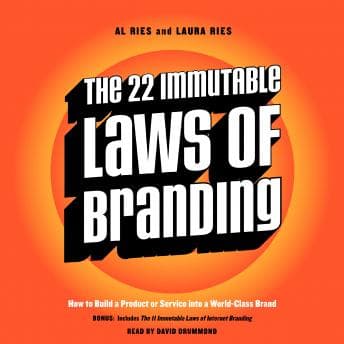

"The Law of Contraction: A brand becomes stronger when you narrow its focus."
I was somewhere around hour three, wedged into the quiet car at 6:47 AM, when this line hit me like a code review comment I didn't want to hear. Because here's the thing—I've been watching my company's product team try to be everything to everyone for the past eighteen months. And the Rieses just called them out from 1998.
Bottom Line: Worth your commute if you're in product, marketing, or just tired of watching companies make the same branding mistakes over and over. The ROI on this audiobook is solid—you'll finish it in about 4 commutes and walk away with a mental framework that actually sticks.
The Laws That Actually Compute
This is basically a design patterns book but for branding. Each "law" is a discrete module—Law of Expansion, Law of Contraction, Law of Publicity, Law of Advertising—and they're structured the same way: principle, examples, counterexamples. As an engineer, I appreciated the systematic approach. It's not fluffy marketing speak. It's more like... if statements for brand strategy.
The examples are dated (we're talking Kodak, Xerox, pre-bankruptcy Starbucks), but that's actually a feature, not a bug. You get to see which predictions held up. Volvo equals safety? Still true in 2024. Their prediction that Heineken would dominate imported beer? Basically correct. Their optimism about certain internet brands in the bonus section? Oof. Let's just say the internet branding laws aged like milk left on the Caltrain platform in July.
The core insight that stuck with me: brands that try to expand into everything end up meaning nothing. It's basically the Unix philosophy applied to marketing—do one thing and do it well. Give and Take applies similar clarity to networking strategy—focus beats sprawl there too. Every time I hear a PM say "but what if we also added..." I'm going to hear Al Ries in my head now.
David Drummond: Functional But Not Exciting
Look, I listen at 1.75x for business books, and Drummond's delivery is... fine for that. He's clear. He enunciates. He reads like a competent engineer giving a tech talk—gets the information across without any flourish.
But here's the honest assessment: he's a bit robotic. There's no variation when he's reading an exciting brand success story versus a cautionary tale of brand dilution. It all comes out at the same emotional frequency. Around hour five, during the internet branding section, I caught myself zoning out—not because the content was bad, but because the delivery had this metronomic quality that my sleep-deprived brain interpreted as white noise.
Perfect for: train, gym. Skip for: deep work where you need engagement to stay focused.
I bumped it to 2x for the last few hours and honestly? Improved the experience. The faster pace forced me to pay attention and masked some of the monotone quality.
The Internet Branding Section: A Time Capsule
The bonus "11 Immutable Laws of Internet Branding" is fascinating for all the wrong reasons. Written in the late 90s/early 2000s, it's full of predictions about which internet brands would dominate. Some hit (Amazon), some... did not.
But here's why it's still worth listening to: the underlying principles about category ownership and first-mover advantage in new markets? Those translated directly to mobile, to social, to AI. I kept thinking about how OpenAI basically followed the Law of the Category by creating a new category rather than trying to beat Google at search.
Could've been a blog post? Honestly, maybe. At 8 hours, there's repetition. The same examples get recycled across multiple laws. But the redundancy actually helped cement the concepts—by the end, I could recite the core principles without thinking.
Who Should Queue This Up
Yes: Product managers, startup founders, anyone who's ever sat in a meeting where someone suggested "extending the brand." Also engineers who want to understand why marketing people make the decisions they do. It's like reading the spec for how branding is supposed to work. If you're looking for the execution side of building a personal brand rather than corporate strategy, Crush It! takes a more hands-on approach.
Maybe: Marketing professionals—you probably know this stuff already, but it's a good refresher and the framework is clean.
Skip: If you want cutting-edge digital marketing tactics or anything about social media strategy. This is principles, not playbook. Also if you need an engaging narrator to stay awake—Drummond won't carry you through a 5 AM commute.
Pushing to Main
Three and a half stars, bumped to 3.5 because the core concepts genuinely changed how I think about product positioning. The narration holds it back from being a must-listen, but the content is solid enough that I've already recommended it to two PMs on my team.
Speed recommendation: 1.75x minimum, 2x if you're comfortable. The pacing is slow enough that acceleration actually helps.
It won't change your life, but it might change how you think about why some products dominate their categories while others become forgettable. And at 8 hours, that's a fair trade for a week of commutes.