
Three hours and seven minutes. That's it. I almost wept with gratitude.
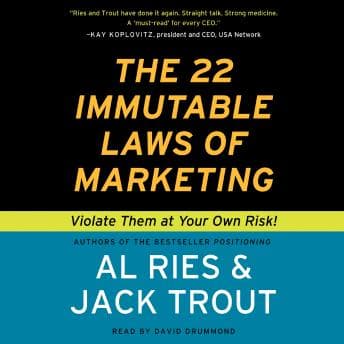
I was meal-prepping Sunday night - Jenny's bibimbap recipe that I always screw up the rice ratio on - and I knocked out this entire book before the gochujang hit the table. Finally, a business book that respects your time. Ries and Trout wrote this thing like they were billing by the hour and actually felt guilty about it.
22 Rules, Zero Filler - A Rare Breed
Here's the structure: each "law" gets its own short chapter, maybe 8-10 minutes each. Law of Leadership (be first, not best). Law of the Category (if you can't be first, create a new category to be first in). Law of the Mind (being first in the mind beats being first in the market). They hit you with the principle, give you two or three examples, and move on. No 40-page detour into the author's childhood epiphany. No "let me tell you about a conversation I had with a CEO on a ski lift in Davos."
The examples are dated - we're talking Xerox, IBM, DEC, Lotus 1-2-3 - and honestly? That's part of the charm. Because you already know which of these companies survived and which didn't, you can grade the authors' predictions in real time. They called the Apple vs. IBM dynamic. They were right about line extension killing brands (hello, every company that slapped their name on 47 products and wondered why nobody cared). Some predictions missed - the book was written in 1993, and the internet basically rewrote several of these laws. But the batting average is impressive.
The Law of Sacrifice hit me hardest. The idea that you have to give things up to succeed - narrow your focus, resist the temptation to be everything to everyone. This is what my parents did instinctively. Now it has a TED talk. My folks ran a dry cleaning business, period. They didn't try to add a laundromat, a tailoring shop, and a coffee bar. They did one thing and owned their block. Ries and Trout would've been proud. That same instinct - do less, own more - is the backbone of Turn the Ship Around!, which argues that real leadership authority comes from the same ruthless narrowing of what you're actually responsible for.
What Drummond Does (And Doesn't Do) With the Material
David Drummond reads this clean and straight. No dramatic pauses, no vocal gymnastics, no attempts to make marketing strategy sound like a spy thriller. He's the audio equivalent of a well-formatted PowerPoint - gets out of the way and lets the content work. For a book like this, that's exactly right. You don't need a performance. You need clarity.
That said, there's a flatness to the delivery that means if you zone out for 30 seconds, you might miss an entire law transition. There's no audible shift between chapters - no tone change, no beat that signals "okay, new concept." At 2.0x speed (my default), I had to rewind twice because I realized I'd crossed from the Law of Duality into the Law of the Opposite without noticing. At normal speed, this probably isn't an issue. At my speed, keep your finger near the 15-second rewind button.
The Expiration Date Problem
Look, I have to be honest. Some of these "immutable" laws are... mutable. The Law of Line Extension argues that extending your brand is always a mistake. Tell that to Amazon, which went from books to literally everything and became the most valuable company on the planet. The Law of Singularity - that only one move will produce substantial results - feels reductive in an era of omnichannel marketing and A/B testing at scale.
But here's why I still think this is worth your time: the underlying mental models are sound even when the specific applications aren't. The discipline of focus, the danger of me-too positioning, the power of owning a word in the consumer's mind ("Volvo" equals "safety" - that example still holds 30 years later). I've seen the violations of these laws fail at three different companies I've consulted for. Startups especially love to ignore the Law of Sacrifice - they want to serve every market segment simultaneously and end up serving none. The same discipline problem shows up in sales organizations too - Mike Weinberg makes a nearly identical argument about focus and prioritization in New Sales. Simplified., though from the trenches rather than the boardroom.
Who Gets the Most From This
If you're a founder or early-stage marketer who hasn't read the positioning classics, this is a fast, punchy introduction. It's frameworks on a napkin. If you've been in marketing for 15+ years, you probably already absorbed these ideas through osmosis and the book will feel like a refresher course you didn't need but don't mind taking.
Skip this if you want tactical, modern playbooks. There's nothing here about digital, social, content marketing, or growth hacking. This is strategic thinking about brand positioning, full stop.
The Consulting Rate on This One
Bottom line: 3 hours of your life for 22 mental models you'll actually use. The ROI math on this one is absurd. Most business books give you one usable idea buried in 10 hours of anecdotes. This gives you maybe 15 usable ideas in the time it takes to meal-prep a mediocre bibimbap. Not every law survives contact with the modern market, but the ones that do are worth more than most full-length marketing books I've pushed through this year.
Jenny would say I'm being harsh about the dated examples. Jenny is right. But I'd rather have a sharp framework with old examples than a bloated book with new ones.