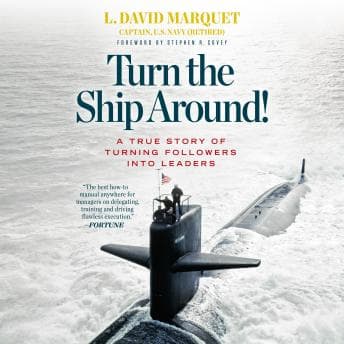

This is basically the anti-micromanagement manifesto, but written by someone who actually had to live it on a nuclear submarine where screwing up means, you know, catastrophic failure.
I started this one at 6AM on a packed Caltrain, half-asleep as usual, and by the time we hit Palo Alto I was genuinely mad at every manager I've ever had. Not because they were bad people, but because Marquet makes such a compelling case that the entire "I tell you what to do, you do it" model is fundamentally broken. And he's got the receipts.
The Impossible Order That Changed Everything
The moment that hooked me: Marquet gives an order on the Santa Fe that's literally impossible to execute on that particular submarine. He'd been trained on a different sub, didn't know the equipment. His crew tries to follow it anyway. When he asks why they'd attempt something impossible, they say "Because you told me to." That's the whole book right there. That one exchange.
He realized he'd inherited a crew trained to be followers, and he was trained to be a know-it-all commander. On a nuclear sub. Where mistakes kill people. The cognitive dissonance must have been wild.
So he flipped it. Instead of "I intend to order you to do X," he pushed for crew members to say "I intend to do X" and explain their reasoning. Sounds simple. It's not. He spends the rest of the book breaking down exactly how hard it is to stop yourself from just... taking control. To let people fail a little so they can learn. To build competence before you hand over authority.
The ROI on This Audiobook Is Stupid High
At 6 hours 27 minutes, this is a three-commute book. Maybe two if you're running late and hit the express. The density-to-length ratio is excellent—no padding, no "let me tell you about my childhood" tangents that plague business books. Marquet tells you what he did, why it worked, what went wrong, and moves on.
The framework he builds—leader-leader instead of leader-follower—is actually applicable. I've already started using "I intend to" language in my team's Slack channels. (My tech lead thinks I'm being weird. He's not wrong, but also our last sprint retro went way better.)
Here's what I wasn't expecting: the book gets pretty specific about submarine operations. You'll learn more about sonar and reactor protocols than you probably need. But it works because those details ground the leadership concepts in reality. This isn't some consultant theorizing about empowerment from a corner office. This is a guy who had to make it work while submerged for months with 135 people who initially didn't trust him.
Marquet Narrating His Own Story—A Mixed Bag
Author-narrated business books are always a gamble. Marquet reads his own work, and it's... fine? His voice is steady, calm, confident. It genuinely feels like he's telling you the story over coffee, which some listeners love. I get it. There's an authenticity you can't fake.
But—and this is real—he doesn't differentiate voices for different crew members, so conversations can blur together. And his delivery is pretty flat for the dramatic moments. When he's describing the transformation of the Santa Fe from worst-performing to first in the fleet, it should feel triumphant. Instead it feels like he's reading a particularly interesting after-action report. Which, fair, he basically is.
I bumped it to 1.5x and that actually helped. His natural speaking pace is deliberate enough that speeding up added energy without losing clarity. 1.25x minimum, honestly.
Who This Is For (And Who Should Skip)
Perfect for: Anyone managing humans. Tech leads, engineering managers, anyone who's ever thought "why won't my team just take initiative?" This is your answer, and you're probably not going to like it. (Spoiler: it's you. You're the problem. I was the problem too.)
Skip if: You want entertainment. This is a business book that earns its reputation, but it's still a business book. It's not going to make your workout fly by. It requires actual attention. Also skip if you're allergic to military culture. Marquet's not chest-thumping about it, but the Navy is the Navy. Rank matters. Protocol matters. If that context annoys you, you'll struggle.
The Debug Summary
Bottom Line: Worth your commute. Marquet took a failing submarine crew and turned them into leaders by stopping himself from leading in the traditional sense. The framework is practical, the stories are specific, and at under 7 hours it respects your time. The narration won't win awards, but this is genuinely one of those "change how you think about management" books that actually delivers.
I finished this one thinking about all the times I've jumped in to solve problems for my junior engineers instead of letting them struggle through. That's not mentorship. That's me needing to feel useful. Chimp Paradox digs into that exact impulse—why our brains default to control mode even when we know better. Marquet would probably tell me to knock it off.
He'd be right.