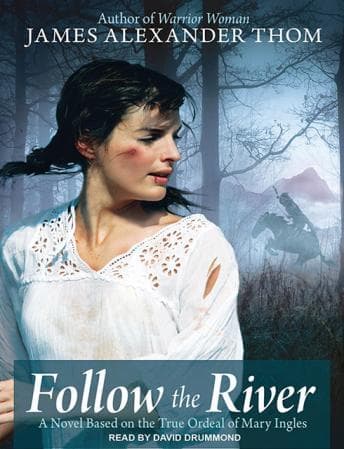

I have a complaint. A real one. Not the kind I level at my students when they turn in SparkNotes summaries instead of actual analysis — a genuine, personal grievance. I started Follow the River during a Saturday morning walk along the lakefront with Denise, which was supposed to be a peaceful, married-people-doing-a-nice-thing kind of walk. We were maybe twenty minutes in when Mary Ingles watched her neighbor get tomahawked in her own doorway, and I stopped dead on the path and made Denise listen to thirty seconds of it through my earbuds. She told me to keep walking. I couldn't really explain why I was so shaken. I'm an English teacher. I've read Cormac McCarthy. I know what violence on the page looks like. But something about hearing it — Drummond's voice dropping into something raw and stunned — hit differently than I expected from a historical novel I'd honestly grabbed because the description reminded me of a lesser-known Willa Cather.
This is why we still read the classics. And this book, published in 1981, absolutely qualifies.
I found that same timeless sense of moral reckoning in Crime and Punishment—the narrator there handles the psychological weight just as deftly.A Thousand Miles of Thom Refusing to Let You Look Away
James Alexander Thom was a journalist before he was a novelist, and it shows — not in a dry, reportorial way, but in the way he refuses to editorialize Mary Ingles' suffering into something tidy. The woman walks roughly a thousand miles through 18th-century Ohio Valley wilderness in late autumn, starving, frostbitten, and occasionally losing her grip on sanity. Thom doesn't dress it up. There's a sequence in the final third where Mary's deterioration — physical and psychological — becomes almost unbearable to sit with. She's bargaining with herself, with God, with her own body. My students would hate this. I love it. It's the kind of writing that makes you feel implicated as a reader, like you're being asked to account for your own comfort.
The historical scaffolding is meticulous without being a lecture. Thom spent real time researching Shawnee culture, and it shows in how he refuses to render them as simple antagonists. The Shawnee characters have interior lives, political pressures, moments of genuine warmth toward Mary. This is 1981 historical fiction, so it's not without its limitations — but it's far more considered than most of its contemporaries.
What Drummond Gets Right, and the One Thing He Doesn't
David Drummond won an Earphones Award for this, and I understand why. His pacing is exactly what this story needs — no rushing, no artificial drama injected where Thom's prose already earns it. The narrator understands that pause is punctuation. When Mary's voice in the narration goes quiet with exhaustion, Drummond goes quiet with her. By the final hours of the audiobook, his rendering of her physical weakness is genuinely affecting — the voice itself sounds depleted in a way that's hard to describe technically but impossible to miss.
His Shawnee characters have real presence. The traders and frontiersmen he differentiates with what sounds like a soft Irish lilt that edges into something rougher, more colonial — it works, mostly, because these characters exist on the margins of civilization in ways that accent captures.
But I have to be honest: the female voices. There's a German woman named Ghetel who travels part of the journey with Mary, and every time Drummond voiced her, I winced slightly. Shrill is the word other listeners have used, and it's accurate. It doesn't ruin anything — the emotional weight of the story carries through — but it's a real distraction in scenes that should be devastating. A male narrator doing female voices is always a tightrope walk, and Drummond mostly manages it, except when he doesn't.
I noticed some of the same vocal range in his reading of Waiting for Snow in Havana, where the memoir’s emotional stakes gave him more room to vary tone without tipping into caricature.Who Walks This River With You
If you loved Paulette Jiles' News of the World — and if you haven't, stop what you're doing — this is its spiritual predecessor. Less elegant in prose style, more brutal in its commitment to physical reality. If you're the kind of listener who needs plot momentum over atmosphere, this might test you around the middle section. It's a slow burn in the truest sense: the kind of fire that takes a while to catch but eventually you realize your whole living room is warm.
Not recommended as background listening. I tried it during papers-at-11PM grading mode and kept stopping to actually pay attention, which is not efficient. This one wants your full presence. The 16 hours felt earned rather than excessive — though I'll admit the middle stretch through the Ohio territory is where Drummond's pacing occasionally tips from deliberate into drawn-out.
But Mary Ingles walked a thousand miles. The least I can do is give her sixteen hours.