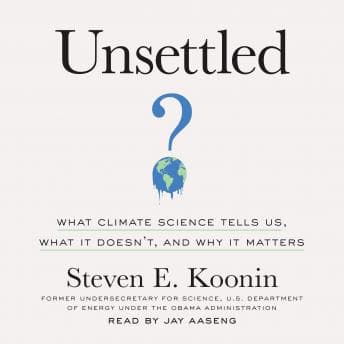

I was debugging a particularly nasty race condition at 11 PM when I decided to throw this on—figured some climate science would either help me think or knock me out. Three hours later, the bug was fixed and I had opinions. Strong ones.
Bottom Line: Worth your commute if you want to understand the actual data behind climate headlines. Koonin's not denying climate change—he's arguing we're terrible at communicating what the science actually says versus what makes good headlines.
The Obama Advisor Who's Going to Make You Uncomfortable
Here's the thing that makes this book interesting rather than just another hot take: Koonin was the Undersecretary for Science under Obama. This isn't some Fox News commentator dunking on climate science from the sidelines. He's a theoretical physicist who's spent decades in the weeds of actual climate models and data.
The core argument isn't "climate change is fake"—it's more like "the telephone game from peer-reviewed papers to IPCC reports to media headlines introduces systematic distortion." He walks through specific examples where the original research says one thing, the summary report says something slightly different, and then CNN says something wildly different. It's basically a debugging exercise for science communication, which—as someone who's watched product managers interpret engineering estimates—felt painfully familiar.
One section that stuck with me: he goes through the actual temperature data from 1940-1970, when global temps decreased despite rising CO2 emissions. Not to say "gotcha, climate change is fake" but to illustrate that the relationship is more complex than simple cause-and-effect, and our models still struggle to explain historical data accurately. If your model can't predict the past, how confident should you be about its future predictions?
When Your Confidence Intervals Are Bigger Than Your Signal
Koonin spends a solid chunk of time on climate models—their strengths, their limitations, and why they disagree with each other by margins that would get any software engineer fired. He's not saying models are useless. He's saying we should be honest about their uncertainty ranges instead of cherry-picking the scariest projections.
This is where my engineering brain got engaged. He talks about how different climate models, given the same inputs, produce wildly different outputs for things like regional precipitation and extreme weather frequency. The spread between model predictions is sometimes larger than the predicted change itself. That's... a significant confidence interval problem.
The ROI on this audiobook is highest if you're someone who reads climate headlines and thinks "that seems oversimplified" but doesn't have the background to articulate why. Koonin gives you the vocabulary and framework to be a more critical consumer of science journalism—not just on climate, but on any complex scientific topic.
Jay Aaseng Gets Out of the Way
Let's talk audio. Jay Aaseng delivers this in a straightforward, factual manner—no dramatic flourishes, no emotional manipulation. Which is exactly right for this material. You want the narrator to get out of the way and let the data speak. He does that.
At 7 hours and change, this is a tight listen. No padding, no repeated anecdotes stretched across chapters. I bumped it to 1.5x and followed everything fine, though some of the statistical discussions benefit from focused attention. Not ideal for half-asleep 6 AM train rides—you'll want to actually engage with this one.
The Uncomfortable Middle Ground
Here's where I'll probably annoy everyone: this book occupies an uncomfortable space. Climate activists will hate it because it undermines the "emergency" framing. Climate skeptics will try to claim it as validation when it's really not. Koonin explicitly states the climate is changing and humans are contributing—he's arguing about magnitude, certainty, and appropriate policy responses.
Compared to something like The Uninhabitable Earth (which I listened to last year and which basically gave me anxiety dreams), this is the cold shower version. For a different kind of cold shower—one that's more about literal breathing than statistical analysis—Breathe: A Life in Flow offers its own form of clarity through discomfort. Less emotional, more "let's look at what the error bars actually say." Whether that's refreshing or infuriating depends entirely on what you're looking for.
Perfect for: focused listening, long flights, anyone who works with data and wants to understand climate science through that lens. Skip if: you need background listening, or you want emotional conviction rather than statistical nuance.
Push to Production?
I walked away from this thinking about how we communicate scientific uncertainty in general. Koonin's broader point—that the gap between scientific literature and public understanding is a serious problem—applies way beyond climate. It's the same dynamic I see in tech journalism, health reporting, economic forecasting.
Is this the definitive word on climate science? No. Should you listen to it as a counterweight to apocalyptic climate coverage? Probably. Will it change your mind? Depends on what your mind was doing before.
I finished this in about 5 commutes, and I'm still chewing on parts of it. That's usually a good sign.








![Steve Jobs [unabridged audiobook] audiobook cover](/_next/image?url=https%3A%2F%2Fcovers.audiobooks.com%2Fimages%2Fcovers%2Ffull%2F9788499923406.jpg&w=1920&q=75)