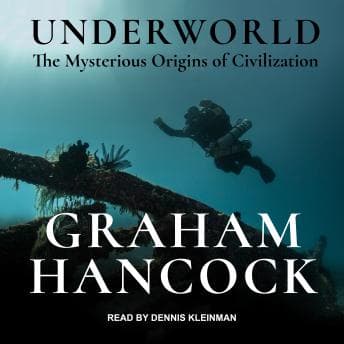

Look, I'll be honest - I expected to bounce off this one hard. Graham Hancock occupies this weird space where half the internet treats him like a prophet and the other half like a crank, and I tend to side with the "show me your peer-reviewed sources" crowd. But here I am, 31 hours and 38 minutes later, having listened to the entire thing across roughly two weeks of commutes plus a Saturday where I was deep-cleaning my apartment and just... kept going. So let's talk about what happened.
31 Hours Is a Lot of Underwater Real Estate
TL;DR: Worth your commute - with caveats.
This is basically a 30-hour scuba diving documentary mixed with alternative archaeology, narrated by someone reading a very dense thesis. Hancock's central argument - that rising sea levels at the end of the last Ice Age swallowed coastal civilizations we've never properly investigated - is genuinely interesting. The hard data about post-glacial flooding is real science. Between 17,000 and 7,000 years ago, sea levels rose dramatically, and over 15 million square miles of habitable land went underwater. That part checks out. The science actually holds up when he's talking about inundation mapping and using bathymetric data to reconstruct ancient coastlines.
Where it gets... Hancock-y... is the leap from "there's submerged land that humans once lived on" to "there was a sophisticated lost civilization that seeded all others." He spends enormous chunks of runtime on flood myths from Mesopotamia, India, Southeast Asia, and Mesoamerica, drawing connections that range from genuinely compelling to "sir, correlation is not causation." The sections on submerged structures off the coast of Japan (Yonaguni) and in the Gulf of Cambay are the highlight reel - Hancock personally dives these sites, and you can hear the genuine excitement even through Kleinman's narration. The Yonaguni underwater formations are wild regardless of whether they're natural or man-made, and his descriptions of diving there made me forget I was standing on a packed Caltrain at 6:47 AM.
But then you'll hit a 90-minute stretch about astronomical alignments in Angkor Wat or the precession of the equinoxes and your eyes glaze over. At 1.5x speed (my default), this book is still over 21 hours. At points it felt like a distributed system with way too many microservices - every chapter spins up a new thread about a different geographic region, a different myth cycle, a different dive expedition, and the orchestration layer between them is... loose.
Dennis Kleinman: Steady Hands on a Long Haul
Here's the thing about narrating a 31-hour nonfiction book that covers Indian mythology, Japanese geology, Mesopotamian flood tablets, and underwater archaeology across four continents: you need a narrator who won't get in the way. Kleinman does exactly that. He's steady, clear, and maintains a consistent pace that doesn't spike your adrenaline but doesn't put you to sleep either. For a book this long, that's more valuable than flashiness.
That said - and I'm being real here - there's a flatness to the delivery of proper nouns from Sanskrit, Tamil, and Arabic that occasionally pulled me out. When you're spending 45 minutes on Dwarka and the Mahabharata, pronunciation confidence matters. It's not bad enough to be distracting, but it's noticeable if you have any familiarity with the source material. (Kevin's parents are from Gujarat and when the Dwarka chapters came up during a drive, he had Opinions about the Tamil pronunciation. Fair.)
No Ray Porter. But Kleinman gets the job done for what is essentially a very long lecture with adventure sequences.
The ROI Calculation
The ROI on this audiobook is complicated. If you're already a Hancock fan, you're getting the most ambitious and evidence-heavy thing he's ever done. The underwater dive sequences are genuinely thrilling. The inundation mapping work is fascinating - he collaborated with actual geologists and the computer modeling of ancient coastlines is the kind of data visualization nerd stuff I live for.
But 31 hours is an enormous time investment, and probably a third of this book could've been cut without losing the core argument. The repetition of the "orthodox archaeology refuses to look at the evidence" framing gets old by hour 15. We get it, Graham. You're the underdog. Move on.
Perfect for: long commutes, road trips, housework marathons. Skip for: anyone who needs tight editing or can't tolerate alternative archaeology frameworks without getting angry.
If you approach this as "interesting guy with a big idea walks me through underwater ruins and ancient myths for a month of commutes" rather than "rigorous scientific argument," you'll have a much better time. I treated it like the world's longest, most elaborate conference talk from that one brilliant-but-undisciplined engineer who always goes over their slot at the offsite. Frustrating? Sometimes. But you remember their talk months later when everyone else's blurs together. Freakonomics has that same quality - the kind of book where the specific arguments fade but the way it rewired how you look at data just... sticks.
Who Gets a Ticket to the Sunken City
This is for you if: you loved Fingerprints of the Gods, you're into alternative history as intellectual entertainment, you want something dense enough to survive 15+ commutes, or you're just fascinated by what's under the ocean.
Skip if: you need books under 15 hours, you'll rage-quit when someone extrapolates from mythology to archaeology, or you need your nonfiction narrators to have vocal range.
I finished this across roughly 14 commutes and one very long apartment cleaning session. Would I listen again? No - once is enough. Am I glad I listened? Yeah. My brain has been chewing on submerged coastlines for a week now, and that's worth something.








![Steve Jobs [unabridged audiobook] audiobook cover](/_next/image?url=https%3A%2F%2Fcovers.audiobooks.com%2Fimages%2Fcovers%2Ffull%2F9788499923406.jpg&w=1920&q=75)