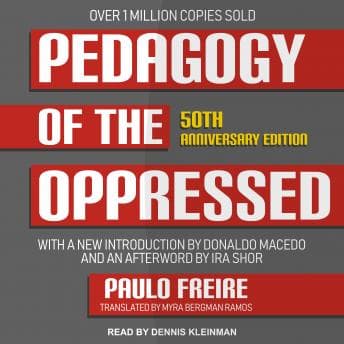

I was halfway through my morning jog along the Charles River when Freire's concept of "banking education" hit me so hard I literally stopped running. Just stood there on the path, probably looking like a confused tourist, while Dennis Kleinman's voice explained how traditional education treats students as empty vessels to be filled. And I thought: this is what's been bothering me about every faculty meeting I've ever sat through.
Look, I came to this book late. Embarrassingly late, honestly, for someone who studies how narratives shape identity. Every critical pedagogy scholar I know has read this thing cover to cover, and here I was, finally getting to it via audiobook in 2024. (Don't tell my dissertation committee.)
The Psychology Underneath the Revolution
What makes Freire's work so fascinating from a psychological standpoint is that he's essentially describing what happens when you internalize oppression—what he calls the "host" and "parasite" dynamic. The oppressed don't just suffer external constraints; they absorb the oppressor's consciousness. They begin to see themselves through the oppressor's eyes.
This is a case study in collective trauma and identity formation, honestly. Freire understood something that psychology research has only recently started to quantify: systemic dehumanization doesn't just limit opportunities—it reshapes how people understand their own agency, their own worth, their own capacity to change their circumstances.
The "banking model" of education he critiques? It's basically learned helplessness institutionalized. Students are positioned as passive recipients, and over time, they internalize that passivity. They stop asking questions because they've been trained to believe they have nothing valuable to contribute. Psychologically, this tracks completely.
Kleinman's Voice Carries Dense Material
Here's the thing about listening to philosophy in audio format—it can go really wrong. Dense theoretical texts need a narrator who understands pacing, who knows when to slow down and let a concept breathe.
Dennis Kleinman gets it. Mostly. His voice has this steady, almost soothing quality that works surprisingly well for material this heavy. You're not going to zone out because he's monotone—there's enough variation to keep you engaged. But he also doesn't overdramatize, which would be weird for a text like this.
I've heard some folks mention his New York accent can be distracting. Honestly? I didn't find it grating. Maybe because I'm from Jersey and that cadence feels like home. Your mileage may vary.
The pacing suits the content. When Freire gets into his more abstract philosophical arguments—and he does, frequently—Kleinman gives you enough space to process. I still found myself rewinding certain sections, but that's the material, not the narrator.
Where It Gets Complicated
I won't pretend this is an easy listen. Freire was writing in the 1960s, and some of the language feels dated. Some of his Marxist framing will land differently depending on your political orientation. And honestly, there are moments where the prose gets so dense that even Kleinman's clear delivery can't save you from needing to pause and think.
The 50th anniversary edition adds interviews with folks like Noam Chomsky and Peter McLaren, plus updated introductions that contextualize the work for contemporary readers. These bonus sections are genuinely useful—they help bridge the gap between 1968 Brazil and wherever you're listening from now.
But here's my honest take: this book rewards active listening. If you're looking for something to half-attend to while doing dishes, this ain't it. I found myself needing to give it my full attention during focused walks, not distracted commutes.
Who Needs This (And Who Should Skip It)
If you're in education, social work, community organizing, or frankly any field where you work with marginalized populations—this is foundational reading. The same goes for Journey of Crazy Horse: A Lakota History, which examines resistance and agency through an entirely different lens but with equally crucial insights. Freire's framework for understanding how oppression operates psychologically and how genuine liberation requires dialogue rather than prescription? Still relevant. Maybe more relevant now than when I was in grad school.
If you're coming to this as a general interest listener curious about critical theory? Be prepared for a workout. This isn't Malcolm Gladwell. Freire isn't trying to make complex ideas accessible through clever anecdotes. He's doing philosophy, and he expects you to meet him there. Skip it if you want something you can absorb passively—you'll just end up frustrated.
The audiobook format actually helps here, I think. Something about hearing the concepts spoken aloud made them stick differently than they might have on the page. (My therapist would probably have thoughts about why auditory processing works better for me with challenging material.)
Standing in My Kitchen With Cold Coffee
I finished this book on a Sunday morning, standing in my kitchen with coffee that had gone cold because I'd forgotten to drink it. That's the kind of book this is—the kind that makes you forget your coffee.
Is it perfect? No. The production quality is fine but not exceptional. Some sections feel repetitive. And Freire's writing style requires patience.
But the core ideas? They've fundamentally shifted how I think about teaching, about research, about the power dynamics embedded in every interaction where one person claims to have knowledge the other lacks. That feeling of genuine intellectual disruption is rare—most books confirm what we already believe. This one challenged me.
That's worth the seven hours and change.