How well do you really know someone you've watched on television for thirty years?
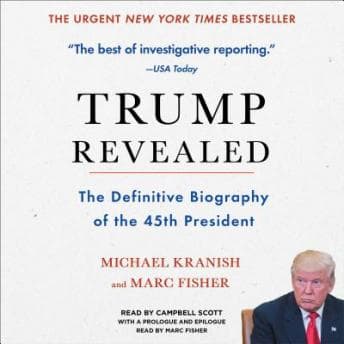
That question kept circling back as I listened to this one during a late-night security assessment writeup for a client. Ranger was snoring under my desk, the coffee had gone cold hours ago, and I was splitting attention between my threat analysis and Campbell Scott walking me through Donald Trump's journey from Fred Trump's shadow in Jamaica Estates to the Oval Office. The two tasks - assessing risk profiles and listening to a biographical deep-dive on one of the most unpredictable public figures in American history - felt oddly complementary.
Twenty-Four Reporters and Still Barely Scratching the Surface
Let me cut to the chase: this is a solid, well-sourced investigative biography that does exactly what it promises. Kranish and Fisher assembled two dozen Washington Post reporters, conducted twenty hours of interviews with Trump himself, and built a chronological account that starts with Friedrich Trump's immigration from Germany and doesn't let up for fourteen-plus hours.
What struck me most was how the book handles the 1973 Justice Department lawsuit against Trump Management for racial discrimination. The Post team doesn't editorialize - they lay out the DOJ's evidence, Trump's counter-suit, the consent decree, and let you sit with it. That willingness to present systemic injustice through documented evidence rather than polemic reminded me of the approach in Caste: The Origins of Our Discontents, which builds its case on historical record with the same kind of discipline. That's good journalism. They apply the same discipline to the Atlantic City casino disasters, where Trump leveraged other people's money into projects that enriched him personally while investors and contractors took the hit. The specific details about the Taj Mahal's financing - the junk bonds, the impossible debt service numbers that anyone with a calculator could have flagged - read like an after-action report on a mission that was doomed from the planning phase.
The seven party affiliation changes over the years got maybe ten minutes of real analysis, which surprised me. I wanted more on the why behind each switch. Was it tactical? Ideological drift? Pure opportunism? The book hints at all three but doesn't commit. That's a gap.
Campbell Scott Does the Heavy Lifting
Scott's narration is the right call for this material. He reads like a veteran news anchor - measured, authoritative, and smart enough to stay out of the way. There's no vocal editorializing, no dramatic pauses designed to make you feel a certain way about the subject. He just delivers. For a fourteen-hour political biography, that restraint is exactly what you need. I listened at my usual 1.25x and Scott held up perfectly - his diction is clean enough that the speed bump didn't swallow any details.
One thing I noticed: Scott handles the direct Trump quotes with a subtle shift in energy without doing a full-blown impression. It's enough to distinguish quoted material from the Post's own reporting, which matters when you're trying to track what Trump actually said versus what the journalists are contextualizing. Smart choice.
Where the Intel Gets Thin
The book was originally published in 2016 and updated after the election, and you can feel the seams. The updated material - covering the final stretch of the campaign and the early presidency - reads like it was bolted on rather than woven in. The earlier chapters about Trump's real estate career, his relationship with Roy Cohn, the Miss Universe pageants, the wrestling appearances - those have the weight of deep research. The later political chapters feel more like excellent newspaper reporting, which isn't the same thing.
I've seen this scenario play out in real life - you build an intelligence picture over months, then get told to add a new theater of operations overnight. The original product is thorough; the addition is competent but rushed. That's this book.
Also - and this is a minor gripe - fourteen hours is a lot of real estate (no pun intended) and there are stretches in the middle covering various business deals that blur together. The pattern repeats: big announcement, leveraged financing, media blitz, mixed results. By the fifth or sixth iteration, you get it. Some editorial trimming would've tightened the whole operation.
Who Should Gear Up For This
If you want a pre-presidency biography built on primary sources and actual journalism rather than opinion - this is your book. It's not a hit piece and it's not hagiography. It's the Post doing what the Post does, which is document everything and let the record speak. Readers looking for either a takedown or a celebration will be disappointed, and I mean that as a compliment to the authors.
Skip it if you're already deep into post-2020 Trump material and are looking for analysis of the presidency itself. This book's strength is everything before November 2016, and the Roy Cohn chapters and the Atlantic City sections alone justify the listen.
Mission Debrief
Worth your time? Here's the debrief: it's a well-built intelligence product on a subject most people think they know but don't. The author - authors, really, plus their team - clearly did their homework. Campbell Scott delivers the goods without getting in the way. It won't change your mind about Trump in either direction, which might be the highest compliment you can pay a biography. It just gives you the data.
Ranger slept through most of it, but he perked up during the wrestling chapter. Make of that what you will.