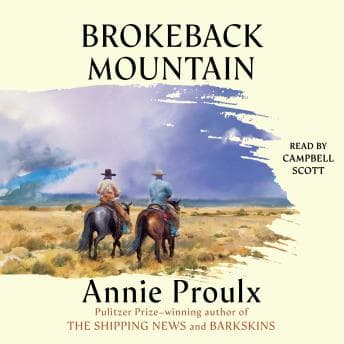

"There was some open space between what he knew and what he tried to believe, but nothing could be done about it."
I listened to this on a Sunday afternoon walk along the lakefront with Denise. She had her own earbuds in, her own book, and we walked in that comfortable married silence that takes years to earn. Sixty-five minutes. We finished at almost exactly the same time, reached the bench near the harbor, and I just sat there for a while not saying anything. She didn't ask. She knows the look.
I teach short fiction every fall. I've assigned Proulx before — "The Half-Skinned Steer," mostly — and I always warn my students that she doesn't write the way they expect. No hand-holding. No emotional stage directions telling you how to feel. She trusts the landscape to do the work, and the landscape in "Brokeback Mountain" is doing heavy lifting from the first paragraph. The Wyoming high country isn't backdrop here. It's the only place in the story where Ennis and Jack are actually free, and Proulx never lets you forget what they're descending back into every time they leave it.
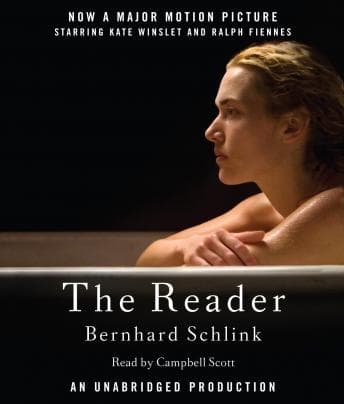
What I wasn't fully prepared for, even knowing the story, was what Campbell Scott does with Proulx's prose at the sentence level.
What Scott Understands That Most Narrators Don't
Proulx writes in a compressed, almost geological style — sentences that feel like they've been weathered down to only what's necessary. There's no fat on this prose. And a lesser narrator would either rush through it, treating the spare language as an invitation to pick up speed, or over-emote, plastering feeling onto words that are deliberately withholding it.
Scott does neither. He reads at the pace of someone who has actually worked outside — unhurried, careful, a little weathered himself. When he hits a line like the one about the space between what a man knows and what he tries to believe, he doesn't pause for dramatic effect. He just... lands it. Lets it sit. The narrator understands that pause is punctuation, and in Proulx's world, what goes unsaid between two men is the whole story.
His voice has a quality I can only describe as earned quiet. Not soft — quiet. There's a difference. Soft would be wrong for this material. Quiet is exactly right for two men who have spent their whole lives not saying the thing.
I do wish — and this is a minor thing — that the character differentiation between Ennis and Jack were a bit more pronounced. Scott reads both with the same measured register, which works philosophically (they're two halves of the same impossible situation) but occasionally made me lose track of who was speaking in the dialogue exchanges. A slight edge in Jack's voice, something with a little more reach and want to it, might've sharpened that contrast. But honestly, for a story this short, it's a small complaint.
What Proulx Is Actually Saying (And Why It Still Matters)
My students would hate this. I love it. And I say that knowing exactly what I mean — they'd hate it because nothing explodes, nobody monologues their feelings, and the ending doesn't give you the catharsis you've been trained by a thousand lesser stories to expect. It gives you something worse and more honest: the shape of a life that didn't happen.
This is why we still read the classics. Or in this case, listen to them. "Brokeback Mountain" was published in 1997 and it has not aged into irrelevance — it has aged into permanence. The violence that ends Jack's story is still happening. The silence that ends Ennis's is still happening. Proulx isn't writing a tragedy about gay cowboys. She's writing about the cost of a world that forces people to live in the gap between what they know and what they're allowed to be.
Sixty-five minutes. That's all it takes. And you'll be thinking about it for days.
If you loved Marilynne Robinson's Gilead — that same quality of a man reckoning with a life shaped by forces larger than himself — this is its spiritual successor, compressed into a single devastating hour. I keep a short list of audiobooks I'd put in that same company, and honestly the only other one I've reviewed that carries that kind of weight in the silences is the Iliad — men trapped by forces they can name but never escape, every line feeling like it's been worn smooth by centuries of being true.
Who Should Listen (And When)
This is focused listening. Not a commute book unless you want to arrive somewhere red-eyed. Not background. Give it a Sunday afternoon, a walk, some space afterward. Worth pausing the faculty meeting for — worth pausing almost anything for, honestly. If you came here for the movie and never read the source material, Scott's reading will show you what Ang Lee was working from: something even starker and more unforgiving than the film managed to be.
If you need plot momentum to stay engaged, this isn't your book. Proulx doesn't move fast. She moves deep.
One hour and five minutes. No filler. No mercy. Essential.