
"The question is always there. I always come up with the same answer."
That line hit me somewhere around hour three, walking the lakefront with Denise on a gray Sunday morning. Lake Michigan looked like hammered pewter, and Michael Berg was wrestling with a question that has no good answer—how do you love someone who participated in atrocity? I stopped walking. Denise asked if I was okay. I wasn't sure.
Campbell Scott Understands That Pause Is Punctuation
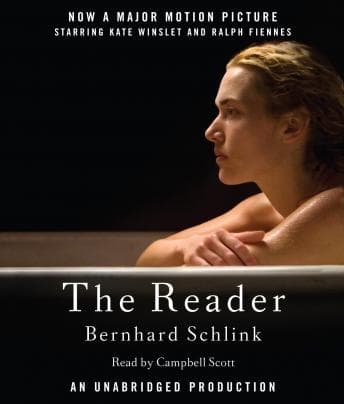
He does something remarkable here. He doesn't perform. He *confesses*. There are no character voices, no accents, no theatrical flourishes—and this is exactly right. The Reader is a first-person account of memory and guilt, and Scott reads it like a man sitting across from you in a quiet room, finally telling you the thing he's never told anyone.
His delivery is eloquent without being showy. When Michael describes those first encounters with Hanna—the bath, the reading aloud, the ritual they develop—Scott finds this urgency underneath the precision. You hear a fifteen-year-old's obsession filtered through an adult's shame. That's not easy. Most narrators would lean too hard into the eroticism or too far into the retrospective wisdom. Scott walks the line.
The trial scenes are where he really earns his Earphones Awards. When Hanna refuses to defend herself, when Michael realizes what she's hiding, Scott's voice gets this plaintive quality—almost bewildered. "He became the young and then the adult Michael for me," one listener said, and I understand exactly what they mean.
What Schlink Is Really Asking
Here's the thing my students would hate about this book: it refuses to give you easy moral ground.
Schlink, himself a law professor, has written something that functions like a legal hypothetical from hell. Hanna is a concentration camp guard who let prisoners burn to death. She is also the woman who bathed a sick teenager, who listened to him read Homer and Chekhov, who wept at *Lady Chatterley's Lover*. The novel doesn't ask you to forgive her. It asks you to understand why Michael can't stop loving her—and then it asks you to sit with your own discomfort about that.
At just over four hours, it's a slim book. Some listeners found it shallow, underdeveloped. I get it. Schlink paints in watercolors, not oils. The prose deserves to be savored—Carol Janeway's translation has this clarity that feels almost cold, which suits the German sensibility. But if you're looking for the sprawling psychological depth of a Dostoevsky, you'll feel cheated.
I think that's missing the point. This is a novel about surfaces and what lies beneath them. About the stories we tell ourselves. About how shame can be more powerful than guilt. Schlink isn't trying to explain the Holocaust or its perpetrators. He's trying to show you how the second generation—Michael's generation—inherited a wound they didn't know how to carry.
The Secret More Shameful Than Murder
I won't spoil it, though the description hints at it. But when you understand what Hanna is hiding, the entire novel reframes itself. You have to go back and re-hear every scene with this new knowledge. It's devastating. And it raises questions about complicity, about choice, about the limits of understanding that have no clean answers.
This is why we still read the classics. (And yes, I'm calling a 1995 novel a classic—fight me.) The Reader does what great literature does: it makes you uncomfortable with yourself. It doesn't let you stand outside and judge. It implicates you.
Who This Speaks To—And Who Should Walk Away
If you loved *Sophie's Choice* or *The Remains of the Day*, this is their spiritual successor. All the King's Men belongs on that shelf too—another meditation on complicity and the stories we construct around our choices. Books about memory, shame, and the lies we tell to survive. If you're looking for action, or clear heroes and villains, or catharsis—you won't find it here. Skip this one if you need resolution. Schlink offers none.
This is focused listening. Not background. Not bedtime. You need to be present. I listened at 1.0x because the author chose those words and I chose to hear them properly. My students would call me ancient for this. They're not wrong.
The production is clean, straightforward. No music, no sound effects. Just Campbell Scott's voice and your conscience.
Some Books Require a Minute
I finished this walking into school Monday morning, standing in the parking lot for an extra five minutes because I couldn't face the copy machine yet. Principal Martinez walked by and asked if I was coming in. I said I needed a minute.
The Reader is one of those books. It's not perfect—there are moments where Schlink's legal-academic mind shows through a bit too cleanly, where you feel the thesis statement underneath the fiction. But Campbell Scott's narration elevates it into something genuinely haunting.
My mom will probably fall asleep during this one. I'll be up thinking about it for weeks.