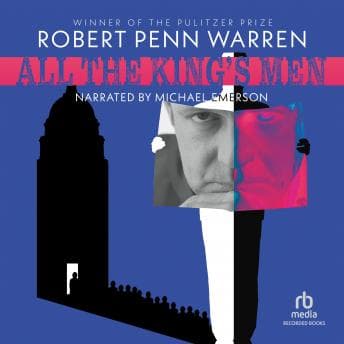

I've been teaching this novel for fifteen years. Assigned it to juniors who mostly SparkNoted their way through, graded essays that missed the point entirely, and delivered lectures about the corrupting nature of power until the words felt hollow in my own mouth. So when I finally sat down with the audiobook - and I mean really sat down, no papers to grade, no lesson plans to outline - I realized I'd been teaching a book I'd stopped actually experiencing.
Michael Emerson fixed that. Twenty-one hours later, I'm reconsidering half my curriculum.
The Voice That Made Me Hear Jack Burden Again
Here's what I forgot about this novel: it's not really about Willie Stark. I mean, yes, the rise and fall of a populist demagogue is the engine driving everything forward. But Warren wrote this book through Jack Burden's consciousness, and Jack is one of the most complicated narrators in American fiction. Cynical but idealistic. Detached but desperate for meaning. The kind of intellectual who uses wit as armor because feeling things directly might kill him.
Emerson gets this. Completely.
His Jack Burden isn't just reading words - he's performing a man in the process of understanding his own life. There's this world-weary quality to his delivery that never tips into melodrama. When Jack goes on his philosophical tangents (and there are many, this is Warren after all), Emerson finds the rhythm in them. The prose that looks dense on the page suddenly has breath and pause and purpose.
And his Willie Stark? Genuinely unsettling. He captures that peculiar charisma of a man who believes his own mythology. The voice shifts - gets bigger, more theatrical - whenever Willie's performing for a crowd versus scheming in private. It's subtle work. The kind of thing you don't notice until you realize you've been holding your breath through a campaign speech.
Where Twenty Hours Stops Feeling Long
Look, I won't pretend this is a breezy listen. Warren's style is digressive by design. Jack Burden doesn't tell you a story - he circles it, approaches it from seventeen angles, retreats into memory, philosophizes about time and causation, then suddenly lands a gut-punch you weren't prepared for. My students call this "boring." They're wrong, but I understand why they say it.
The audiobook actually helped me appreciate the architecture of Warren's prose in a way reading never did. When you're listening at 1.0x (yes, I'm that person), you can't skim the philosophical passages to get to the plot. You have to sit in them. And Emerson's pacing makes that sitting feel less like homework and more like... meditation? That's too pretentious. Let me try again: it feels like listening to someone genuinely think out loud.
There are sections in the middle - Jack's research into Judge Irwin's past, the "Great Twitch" philosophy - where I could see impatient listeners checking out. But these aren't tangents. They're the spine of the novel. Emerson seems to understand this. He doesn't rush through them to get to the "good parts." He trusts Warren's structure.
Why This Still Matters (And I Don't Mean That in a Corny Way)
I listened to most of this walking the lakefront with Denise, who kept asking why I looked so troubled. Hard to explain that a 1946 novel about Louisiana politics was hitting uncomfortably close to... well, everything. Willie Stark's appeal to the common man against corrupt elites. His genuine desire to do good corrupted by the methods required to gain power. The way everyone around him becomes complicit.
Warren wasn't just fictionalizing Huey Long. He was writing about what happens when idealism meets political reality. And Emerson's narration strips away any comfortable historical distance. This doesn't sound like a period piece. It sounds urgent.
The Audie nomination makes sense. The Earphones Award for Emerson makes sense. What surprises me is that this audiobook isn't more widely discussed. It's one of the best pairings of narrator and material I've encountered.
Who Should Listen (And Who Should Skip)
If you bounced off this book in high school or college - and statistically, you probably did - give the audiobook a chance. Emerson's performance provides the interpretive layer that makes Warren's prose accessible without dumbing it down. You'll still need patience. This is a slow burn that rewards attention.
If you've never read it and you're interested in American political fiction, this is essential. Skip the movie adaptations. (Both of them. Seriously.) The novel is the thing, and this audiobook is the best way to experience it short of having Warren himself read it to you.
If you want something plot-driven and fast-paced, skip this one. Warren is interested in consciousness, not action. The political machinations matter, but they matter because of what they reveal about the people caught in them. That same focus on interior life over plot mechanics is what makes Dutch House: A Novel work so well—though Patchett's prose is far more forgiving than Warren's.
I'm updating my syllabus next semester. Required listening, not just required reading. My students will hate me for the twenty-one hour runtime. But maybe, just maybe, a few of them will hear what I finally heard again.