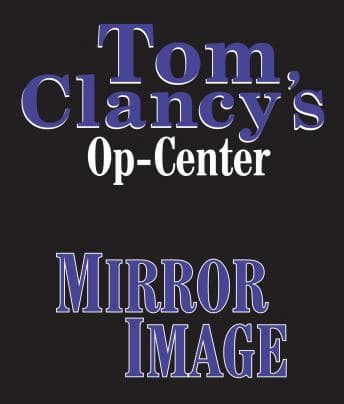

The Cold War thriller is a genre that functions like a psychological Rorschach test — what you see in the geopolitical chaos says more about you than about the actual politics. And Mirror Image, the second Op-Center novel, is a fascinating case study in what happens when you try to build a character-driven espionage story but can't quite decide how much patience you're asking your audience to have.
I was making chana masala on a Sunday afternoon — one of those elaborate, three-hour affairs where you roast your own spices and pretend you're not procrastinating on a literature review — when I started this. Nearly eleven hours is a commitment. And I'll be honest: the first couple of hours tested that commitment.
The Slow Burn Before the Burn
Here's the thing about Mirror Image that nobody preparing you for this audiobook will adequately convey: it drags at the start. Not in the way a literary novel takes its time building atmosphere — that I can respect. This is more the mechanical kind of drag, where Jeff Rovin (because let's be real, Clancy's name is on the cover but Rovin is doing the heavy lifting here) wants you to understand every bureaucratic corridor, every organizational flowchart, every procedural handshake before you're allowed to care about what's actually happening. The writing goes beyond Clancy's typical detail-orientation into something that feels like reading a policy briefing with occasional dialogue.
But. And this is a meaningful but. Once the premise locks into place — two mirror-image crisis centers, one American, one Russian, essentially playing chess while their respective governments threaten to implode — the psychological dynamics get genuinely interesting. The protagonist exhibits classic compartmentalization patterns, the kind where professional competence masks deep uncertainty about whether the institutional framework they serve even deserves loyalty. That's a real human thing. I found myself asking: why does the Russian counterpart function as a true mirror rather than just an antagonist? Because the book is quietly arguing that the same personality types get drawn to power structures regardless of the flag on the building. That's not a bad thesis for a genre novel. The psychological mirroring at the heart of this story reminded me of the identity dynamics I was tracking in Dark Horses, where characters are also defined by the institutional pressures pulling at their sense of self.
Michael Kramer and the Monotone Question
So there's this divide among listeners about Kramer's narration, and I think I understand both sides. He's a decorated narrator — AudioFile Earphones Awards, Audie finalist, the whole résumé. And his character differentiation is clean. You know who's speaking. He handles the ensemble cast (and there are a lot of characters cycling through this thing) with enough vocal variation that you're never lost.
But compared to his work on, say, Sanderson's Stormlight Archive — where he gets to be theatrical, where the material practically begs for vocal dynamism — this feels restrained. Almost deliberately flat. Whether that reads as "monotone" or "appropriate for bureaucratic espionage" depends entirely on what you want from your thriller narration. I landed somewhere in the middle. There were stretches, especially during the procedural early chapters, where I wished he'd inject more tension into his delivery. But during the espionage sequences — particularly the spying scene involving comics as a communication device, which is such a wonderfully specific Cold War-adjacent detail — his measured pace actually works. It lets the absurdity of tradecraft sit with you.
If you've listened to the first Op-Center audiobook with Kramer, you know what you're getting. Some listeners consider that first book stronger, and I get it — the novelty of the premise carried more weight. Mirror Image is the sophomore entry doing what sophomore entries do: deepening the world at the cost of some momentum. It's reportedly better than the third book, so think of it as the middle child that at least has interesting things to say at dinner.
Who This Is Actually For (and Who Should Walk Away)
This is for focused listening. Do not put this on during a jog. I tried, and I lost the thread of three different Russian political factions somewhere around the Charles River. This is a sit-down, pay-attention audiobook for people who genuinely enjoy the machinery of geopolitical thrillers — the meetings, the intelligence briefings, the slow accumulation of tension through information rather than action.
If you need your thrillers to move like a Jason Bourne movie, psychologically this doesn't track for you. Skip it. If you're a Clancy completist or an Op-Center series follower, it's worth your time but probably not a full credit — wait for a sale. The eleven-hour runtime is dense but not always efficiently so.
Content-wise: there's violence and some sexual content, nothing extreme but worth noting if that matters to your listening preferences.
My Therapist Would Have Thoughts About This Organization
The real psychological pull of Mirror Image isn't the plot — it's the organizational paranoia. The idea that somewhere across the world, your exact functional equivalent exists, serving opposite interests with identical methods. That's identity anxiety dressed up as geopolitics. The research actually shows that mirror-image perception — where each side of a conflict sees themselves as rational and the other as aggressive — is one of the most robust findings in political psychology. Rovin stumbles onto something genuinely smart here, even if the execution sometimes buries it under procedural weight.
Worth a listen if you're patient. Worth a full credit? Probably not. But there's a real idea in here, buried under the bureaucracy, and sometimes that's enough.