
"I don't want to be his daughter anymore."
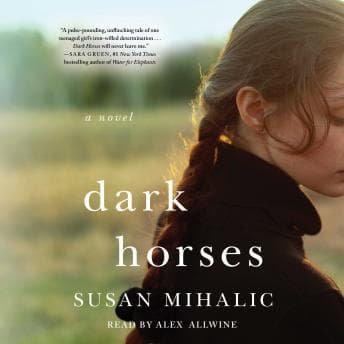
That line hit me somewhere around hour three, and I had to pause the audiobook. Just sat there in my apartment, Diego curled on my lap, Frida staring at me from her perch like she knew. I was designing wedding invitations—all soft pinks and promises—while listening to Roan Montgomery describe the systematic destruction of her childhood by the one person who should have protected her.
The contrast almost broke me.
The Weight of Silence
Susan Mihalic doesn't flinch. That's the first thing you need to know. This isn't one of those books that hints at darkness and cuts away. Roan's abuse isn't metaphor or backstory—it's the air she breathes, the water she swims in. She's fifteen, an Olympic-caliber equestrian, and her father has been sexually abusing her for years. The way Mihalic writes Roan's compartmentalization—this clinical, almost detached way she separates "riding" from "what happens after"—it's devastating because it's so recognizable. Survivors will know exactly what she's doing. The rest of us get to understand, maybe for the first time, how a person survives the unsurvivable.
Alex Allwine's narration carries this weight without ever making it feel performative. Her voice for Roan has this flatness sometimes, this careful control, and it took me a while to realize that's not a flaw—that's Roan. That's what survival sounds like. When Roan's with Will Howard, the boy who starts to show her what normal might feel like, Allwine's voice warms. Opens up. The contrast is subtle but it's there, and it gutted me.
Horses as Escape and Trap
Here's what makes this book different from other abuse narratives I've listened to (and I've listened to a lot—I process heavy things through audiobooks, it's a whole thing). The equestrian world isn't just setting. It's the mechanism of control. Roan's father isn't some random monster—he's her coach. Her path to the Olympics runs directly through him. Every ribbon, every championship, every dream she's ever had is tangled up with her abuser.
Mihalic clearly knows this world inside out. The author taught therapeutic horseback riding, and you can feel that authenticity in every scene at the barn. The rhythm of training, the relationship between rider and horse, the way Roan's body knows what to do even when her mind is somewhere else entirely. Her horse becomes the one relationship in her life that isn't corrupted. Almost.
I ugly-cried at chapter... honestly, I lost count. Somewhere past hour seven, when Roan finally starts to crack, when the compartments start leaking into each other. Allwine's delivery in those scenes—the way her voice breaks just slightly, just enough—my heart. MY HEART.
Not a Background Listen
Let me be real with you: this book is almost too intense. There were moments I had to switch to something lighter just to breathe. The psychological control Roan's father exerts is rendered so precisely, so unflinchingly, that I found myself tensing up during scenes where nothing overtly bad happens. Because you know. You know what's coming, or what came before, or what he's thinking. That constant dread is exhausting in the way it should be.
The pacing is deliberate—this isn't a thriller that rushes toward resolution. It's a slow burn of awakening, of Roan gradually seeing her life through Will's eyes and realizing how wrong everything is. At 10 hours and change, it asks for your full attention. Don't put this on while you're doing dishes. Give it a dark room, give it your focus, give it the respect this story deserves.
Who Needs This Story (And Who Should Wait)
If you loved My Absolute Darling or Room, this is your territory. The Glass Castle belongs in that same conversation—Jeannette Walls writing about her father hit me with that same particular grief, the kind that comes from loving someone who was supposed to be safe. If you need stories about survivors reclaiming their power—not easily, not prettily, but with teeth—Roan Montgomery will stay with you.
But please, please check in with yourself before starting. The abuse is explicit in its emotional reality. There's animal-related content that might be triggering for some. If you're in a fragile place, save this one for later. For everyone else? This is a rainy Sunday book, but the kind of rainy Sunday where you're processing something heavy and you need company in the dark.
Abuela Would Have Wept
She would have clutched her rosary and prayed for Roan and then called me to talk about it for an hour. She understood stories like this—the ones that hurt because they're true, even when they're fiction. The ones that matter because they refuse to look away.
Alex Allwine was the perfect narrator for this. Not overdone, not melodramatic, just... present. Steady. Like a hand on your back while you cry.
I'm adding this to my spreadsheet. Crying sessions: at least three, maybe four if you count the one where I just stared at the ceiling for ten minutes after it ended.